Your libido is a health biomarker (part 1)
What your libido can reveal about your body.
Table of contents
What better time than Valentine’s season to talk about a topic that’s still too often taboo: libido.
Libido isn’t just psychological. It’s also a biological signal.
Because it relies on the same major systems that shape overall health, the nervous system, circulation, metabolism, and hormones, a sustained change in desire or in physiological response can sometimes reflect an underlying imbalance: under-recovery and fragmented sleep, high stress load, low energy availability, metabolic dysregulation, inflammation, thyroid dysfunction… or simply a life phase in which physiology is being recalibrated.
That’s why it deserves a more precise lens with practical reference points.
This week, we explore the biology of libido:
What is libido, and how is it different from physiological response?
Which systems drive it (brain, autonomic nervous system, circulation, hormones)?
Which hormones are involved in women and in men?
Why does libido naturally fluctuate over a day, a cycle, and a lifetime?
Want to make this signal measurable?
With Lucis, you can connect symptoms to actionable biomarkers (metabolism, inflammation, hormones, stress/sleep) and identify what’s most likely weighing on your energy… and your libido.
In Part 1, we’ll cover the most common drivers of a sustained drop, the biomarkers that help orient the hypothesis, and a functional framework to rebuild the foundations.
What is libido?
Libido refers to the level of motivation for intimacy: interest, drive, and the likelihood of initiating or seeking an interaction.
Two clarifications prevent most misunderstandings:
There is no universal “normal.” Libido varies with age, health status, sleep, stress, cognitive load, hormonal balance, available energy, and relational context.
Libido ≠ physiological response. Desire is primarily a central phenomenon (brain). Physiological response (lubrication/erection, sensitivity, vasodilation) is largely peripheral (circulation, tissues, autonomic nervous system). These two dimensions can change independently.
Two common patterns of desire
The literature commonly describes two ways desire can emerge, without ranking one above the other:
Initiating desire (“spontaneous”): motivation appears before stimulation.
Contextual desire (“responsive”): motivation appears after entering a favorable context (safety, mental availability, closeness, gradual stimulation).
This distinction matters: the absence of “spontaneous desire” does not automatically mean “low libido.” It can reflect a predominantly contextual pattern, often more sensitive to recovery, stress, and available attention.
Which systems drive libido?
EN - Asset 1_ LIBIDO
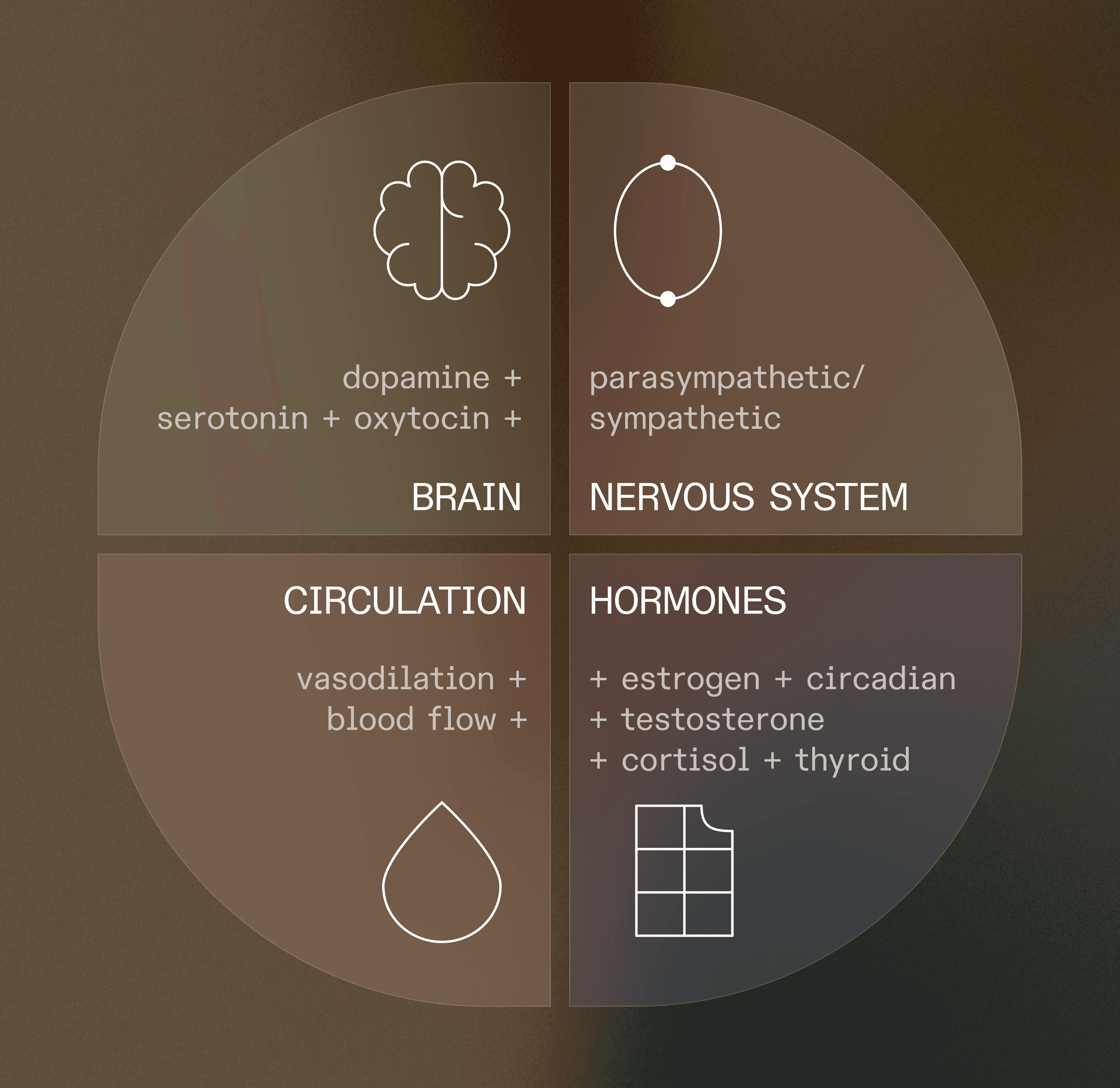
For a functional read, three systems are central, brain, autonomic nervous system, endocrine, with a fourth transversal pillar: circulation, which shapes peripheral response.
1) The central nervous system (brain)
The brain integrates internal signals (energy, stress, sleep) and external signals (environment, relationship, stimulation) to generate or inhibit desire.
Key regions:
Hypothalamus: the conductor. It links internal state (energy, stress, sleep) to hormonal regulation (it initiates signals to the hormonal axes).
Limbic system: the motivation hub. It binds emotions to memory and orients approach vs. avoidance.
Prefrontal cortex: conscious control. It manages attention and anticipation, but can also inhibit response when mental load, anxiety, or rumination dominate.
Neurotransmitters involved:
They modulate three essential levers: motivation, braking, and safety.
Dopamine: the engine of motivation and reward anticipation. When energy is low and fatigue builds, that “engine” can slow down.
Serotonin: mood regulation and inhibition. In certain contexts (including some treatments), increased serotonergic signaling can reduce desire or blunt response.
Oxytocin / endorphins: messengers associated with bonding, calming, and analgesia. They support relaxation and recovery, which helps the body become more physiologically available.
2) The autonomic nervous system
This system shapes whether the body is in calm/safety or alert—and directly influences the quality of physiological response.
Parasympathetic (“calm / recovery”): supports local circulation, tissue relaxation, sensitivity, and lubrication/erection.
Sympathetic (“action / alert”): useful short-term, but if it remains dominant too long (stress, poor sleep, under-recovery), the body prioritizes vigilance and energy conservation. In that state, physiological availability drops and desire tends to decrease more often.
Simple marker: the more the body stays in alert, the harder it becomes to mobilize a smooth physiological response.
3) Blood flow
Physiological response relies on a simple mechanism: at the right time, blood vessels need to dilate to increase blood flow to the relevant tissues.
In men: essential to achieve and maintain an erection.
In women: essential for tissue engorgement, sensitivity, and more effective lubrication.
Simple marker: when circulation is less efficient (fatigue, chronic stress, metabolic dysregulation, inflammation), physiological response can become less reliable.
Hormones (women / men)
Women (cycle = signal)
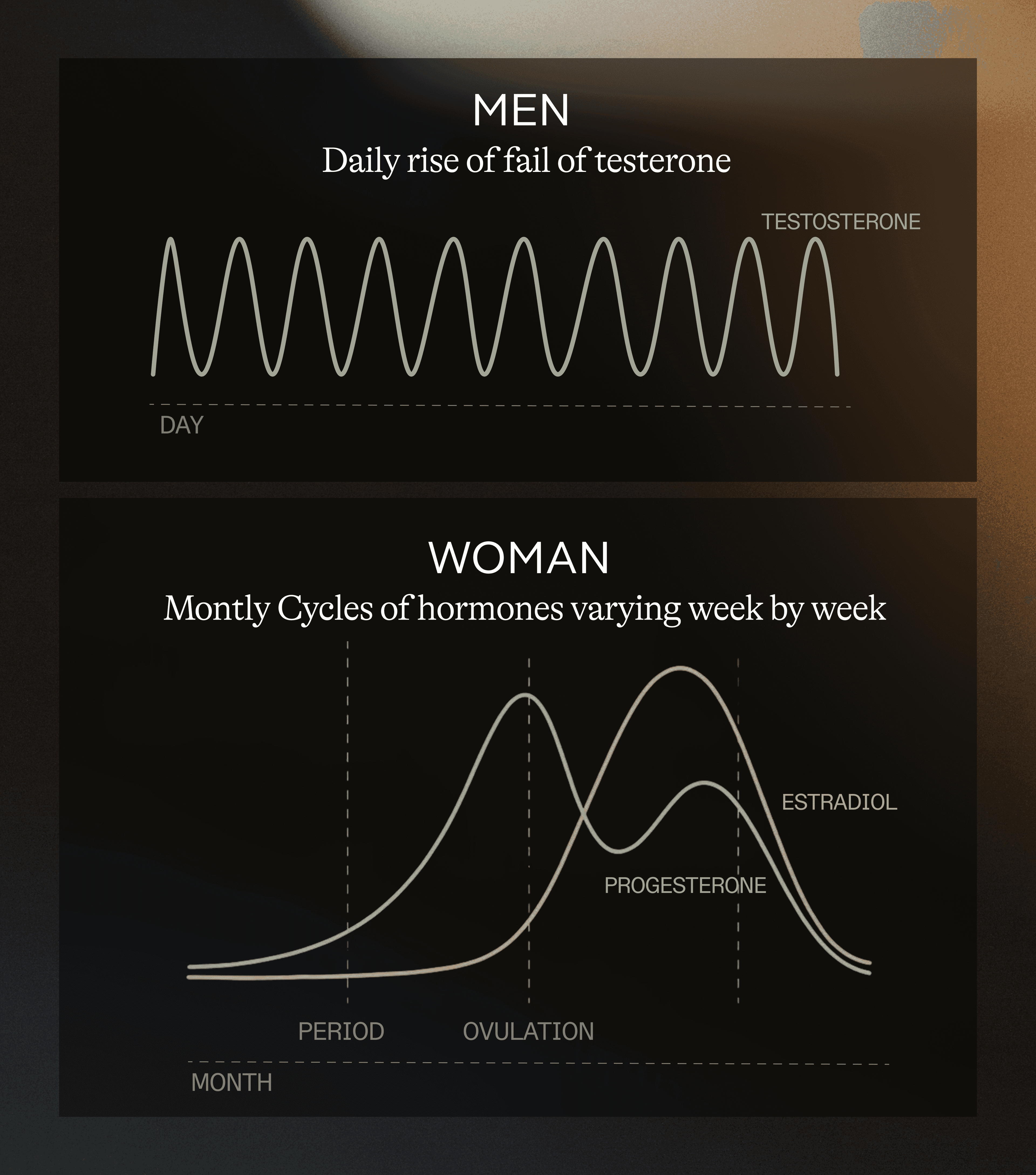
Women are cyclical: hormones vary across the month, and libido can fluctuate accordingly. Keep three levers in mind: estrogen (body response), available androgens (drive), and stress/sleep/energy (the overall “volume knob”).
Sex hormones
EN - Asset 2_LIBIDO
Estrogen (estradiol): rises in the first half of the cycle and peaks around ovulation. This rise often supports physiological response (comfort, sensitivity, lubrication) and may coincide with higher desire in some women.
Progesterone: increases after ovulation. For some women, the luteal phase comes with a stronger recovery need and lower availability, sometimes translating into lower drive in the second half of the cycle.
Testosterone (and availability): supports drive (initiative, motivation). It may rise slightly around ovulation, but the key factor is often availability (frequently influenced by SHBG), not total level alone.
“Modulator” hormones
Cortisol: chronic stress and sleep debt keep the system in alert mode, often resulting in less desire and a less fluid physiological response.
Thyroid hormones: set baseline energy. When energy drops (slower thyroid function or less efficient conversion), libido often declines simply due to reduced resources.
Men (rhythm = more daily)
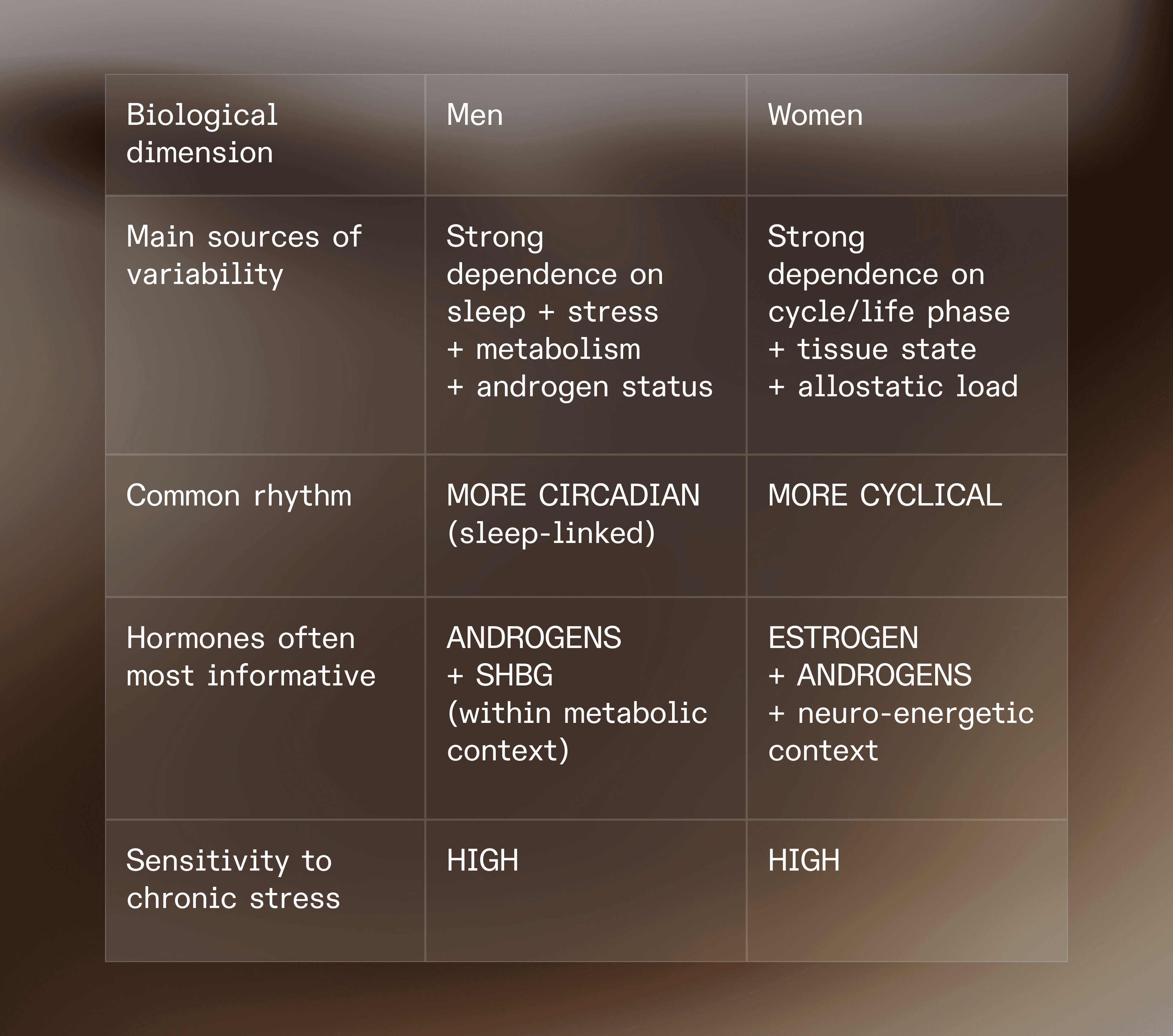
Men are, on average, more circadian: hormones tend to vary more across the day and with sleep than across a month. Three levers dominate: androgens (drive), metabolism + circulation (body response), and stress/sleep (major brake).
Testosterone (and availability): supports desire, motivation, and energy. A total level alone can be misleading: SHBG (a transport protein) can bind a portion of testosterone and reduce the fraction that’s actually available.
Estradiol: produced from testosterone, it contributes to certain physiological balances. It can vary with body composition and metabolic context, with a potential impact on libido.
Cortisol + sleep debt: lower drive, fatigue, and less reliable physiological response when alertness becomes chronic.
Thyroid: same logic as in women when baseline energy drops, libido often follows.
Changes across the lifespan
Women: postpartum/breastfeeding, perimenopause/menopause, starting/stopping contraception, low energy availability, and chronic stress are phases where neuro-endocrine balance shifts, with potential impact on desire and/or physiological response.
Men: aging, body composition, sleep quality (including sleep apnea), cardio-metabolic health, and stress load explain much of the variability between individuals.
EN - Asset 3_LIBIDO
Libido isn’t an “on/off,” and it isn’t an isolated metric. It depends on identifiable biological mechanisms: brain (motivation), autonomic state (alert vs recovery), circulation (peripheral response), hormones (modulation), and metabolism (available energy).
What this means is simple:
a short-term fluctuation is often physiological (cycle, sleep, stress, life phase),
a sustained drop can sometimes be a signal: under-recovery, high stress load, metabolic dysregulation, inflammation, thyroid issues, or reduced hormone availability.
In Part 2, we’ll get practical: the most common causes, the most useful biomarkers by profile (women/men), and a functional approach to rebuild the foundations.
References
Argiolas, A., & Melis, M. R. (1995). Neuromodulation of penile erection: An overview of the role of neurotransmitters and neuropeptides. Progress in Neurobiology, 47(4–5), 235–255.
Dominguez, J. M., & Hull, E. M. (2005). Dopamine, the medial preoptic area, and male sexual behavior. Physiology & Behavior, 86(3), 356–368.
Georgiadis, J. R., & Kringelbach, M. L. (2012). The human sexual response cycle: Brain imaging evidence linking sex to other pleasures. Progress in Neurobiology, 98(1), 49–81.
Hull, E. M., Muschamp, J. W., & Sato, S. (2004). Dopamine and serotonin: Influences on male sexual behavior. Physiology & Behavior, 83(2), 291–307.
Levin, R. J. (2003). The ins and outs of vaginal lubrication. Sexual and Relationship Therapy, 18(4), 509–513.
McKenna, K. (1999). The brain is the master organ in sexual function: Central nervous system control of male and female sexual function. International Journal of Impotence Research, 11(Suppl 1), S48–S55.
Meston, C. M., & Frohlich, P. F. (2000). The neurobiology of sexual function. Archives of General Psychiatry, 57(11), 1012–1030.
Pfaus, J. G. (2009). Pathways of sexual desire. The Journal of Sexual Medicine, 6(6), 1506–1533.
Stoléru, S., Fonteille, V., Cornélis, C., Joyal, C., & Moulier, V. (2012). Functional neuroimaging studies of sexual arousal and orgasm in healthy men and women: A review and meta-analysis. Neuroscience & Biobehavioral Reviews, 36(6), 1481–1509.
Written by Anaïs Gautron
More insights, straight to your inbox.
New articles on biomarkers, performance, and wellness. No noise, just substance.