Sleep 101 1/2: what really happens when you sleep
How sleep works: cycles, stages, hormones, and what disrupts your nights.
Table of contents
📌 This article is Part 1 of our Sleep 101 series. Part 2 is now available: Sleep 101 2/2: how to improve your sleep quality in 9 steps →
Sleep is often described as a simple period of rest. But while you sleep, your brain sorts, consolidates, and clears information. Your nervous system regulates itself. Your immune system becomes active. Your metabolism adjusts. Your tissues repair. Your hormones follow precise rhythms.
This is why two people can spend 8 hours in bed and wake up feeling completely different. The difference is not only about duration. It is also about quality, continuity, timing, regularity, and sleep architecture.
This article lays the foundations: how sleep works, why it matters, what can disrupt it, and which signs may point to non-restorative sleep.
Sleep is not one uniform block
A night of sleep is organized into cycles.
On average, one cycle lasts around 90 minutes, and a full night usually includes 4 to 6 cycles. Each cycle alternates between several sleep stages, each with its own role. This is called sleep architecture.
This architecture matters because each stage supports different functions: physical recovery, memory, immunity, emotional regulation, metabolism, and brain clearance.
Getting enough sleep does not automatically guarantee restorative sleep. Your cycles also need to be complete, relatively stable, and deep enough.
The main stages of sleep
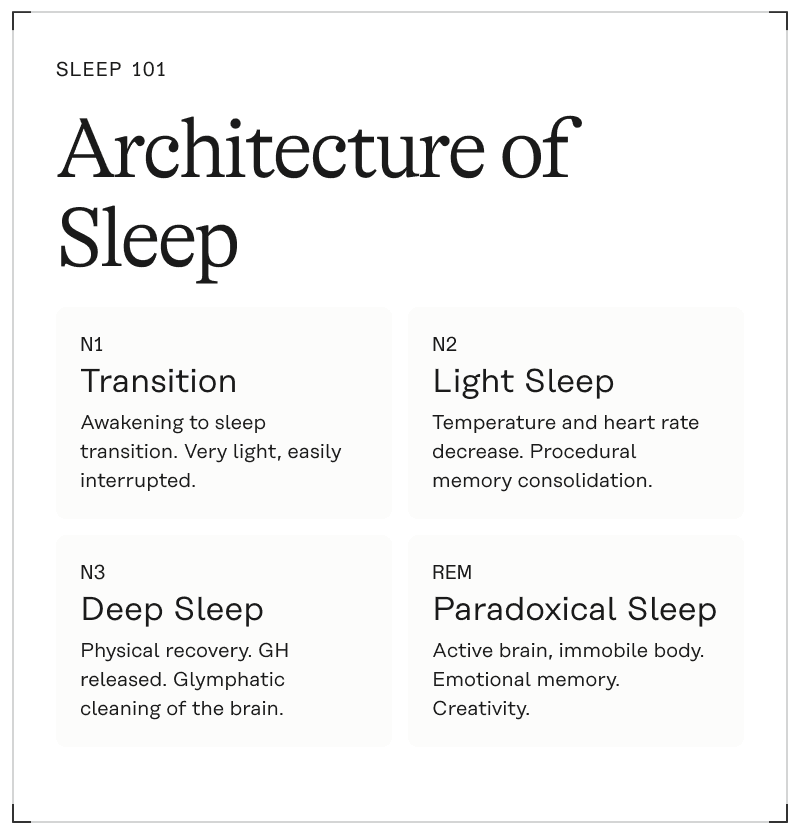
1. N1: entering sleep
This is the transition phase between wakefulness and sleep. The brain begins to slow down, but sleep remains very light. You can still be easily woken by a noise, light, a thought, or a bodily sensation.
If you feel like you are "dozing" without truly sleeping, or like you remain stuck in very superficial sleep, it may suggest difficulty transitioning into deeper sleep stages.
2. N2: stabilized light sleep
N2 sleep often represents the largest portion of the night. The body slows down further: body temperature drops, heart rate decreases, and breathing becomes more regular.
It is also an important stage for consolidating certain forms of memory. The brain is not switched off: it sorts, encodes, and stabilizes information.
Good sleep is not only deep sleep. Light sleep also has a role. But if it becomes too dominant at the expense of deep sleep or REM sleep, recovery may be incomplete.
3. N3: deep sleep
Deep sleep is often considered the most physically restorative sleep stage. It is especially present in the first half of the night, particularly in the first cycles after falling asleep. This is one reason why bedtime timing matters: going to bed very late can reduce access to this deep recovery window, even if total sleep duration seems adequate.
During this stage, several key processes are supported:
Muscle and tissue recovery increases.
Growth hormone secretion is higher.
The immune system regulates itself.
Metabolic regulation: insufficient deep sleep promotes weight gain and insulin resistance.
Blood pressure drops and the heart recovers. Insufficient deep sleep is associated with an increased risk of hypertension and cardiovascular events.
The brain activates metabolic clearance mechanisms, particularly through the glymphatic system. The body lowers its state of alertness and enters a true phase of restoration.
When deep sleep is insufficient or fragmented, you may sleep for a long time but wake up with heavy fatigue, brain fog, poor muscular recovery, or low energy.
4. REM sleep: active brain, immobilized body
REM sleep, also called paradoxical sleep, is mostly present in the second half of the night. During this stage, the brain becomes highly active, while the body remains largely immobilized to prevent you from physically acting out your dreams. It is the stage most associated with vivid dreams.
REM sleep plays a central role in:
emotional regulation,
processing lived experiences,
emotional memory,
learning,
creativity,
mental flexibility,
integration of information,
defusing stress and fears.
If you systematically shorten your night by waking up too early, you may lose a significant part of REM sleep.
Why is sleep so important for health?
Sleep influences almost every major system in the body.
Metabolism and blood sugar
Insufficient or fragmented sleep can reduce insulin sensitivity and therefore disrupt hunger regulation and increase cravings for sweeter or more energy-dense foods.
Over time, chronically disrupted sleep may contribute to a less favorable metabolic terrain: less stable blood sugar, easier fat storage, and slower recovery.
Nervous system and stress
Sleep is one of the major regulators of the stress axis. Normally, cortisol follows a circadian rhythm: higher in the morning to support wakefulness, then gradually lower in the evening to allow sleep onset. But in chronic stress, this rhythm can become disrupted. Some people remain "activated" in the evening: racing thoughts, internal tension, difficulty switching off, nighttime awakenings, feeling exhausted but wired.
In this context, the issue is not only sleep itself. It is often a nervous system that can no longer downshift sufficiently.
Immunity and inflammation
Sleep contributes to immune regulation. Sleep deprivation can alter cytokine production, increase vulnerability to infections, and maintain an inflammatory terrain in some people.
Conversely, inflammation can also disrupt sleep. It is a bidirectional loop: poor sleep leads to higher inflammation, and inflammation leads to more fragmented sleep.
Brain, memory, and mental clarity
During sleep, the brain consolidates information, sorts experiences, reinforces certain forms of learning, and clears metabolic waste.
When sleep is insufficient, the effects can appear quickly:
reduced concentration,
less efficient memory,
stronger emotional reactivity,
difficulty making decisions,
brain fog,
feeling less resilient in the face of daily stressors.
Sleep is a central biological function for maintaining mental clarity and emotional stability.
The key hormones of sleep
Melatonin
Melatonin is first and foremost a circadian signal. It tells the brain that night is coming. Its production increases when light decreases, especially when exposure to blue light and bright light goes down.
This signal can be disrupted by:
screens late in the evening,
bright light at night,
irregular schedules,
lack of natural light in the morning,
chronic stress,
certain medications or substances (notably caffeine, alcohol, beta-blockers),
jet lag or atypical work schedules.
If the melatonin signal is delayed, falling asleep can become more difficult, even when fatigue is present.
Cortisol
Cortisol is often reduced to "the stress hormone," but it is also a rhythm hormone. It helps the body wake up, mobilize energy, and respond to the demands of the day. The problem appears when it is too high at the wrong time, particularly in the evening or at night.
High nighttime or evening cortisol can contribute to:
difficulty falling asleep,
light sleep,
nighttime awakenings,
early morning awakenings,
feeling tired but unable to relax.
In this case, it is often necessary to work upstream on stress load, light exposure, food intake, blood sugar, training, daily rhythm, and recovery.
Growth hormone
Growth hormone is strongly linked to deep sleep. It contributes to tissue repair, maintenance of muscle mass, recovery, and certain aspects of metabolism. Insufficient deep sleep can therefore have concrete effects: slower athletic recovery, more persistent aches and pains, physical fatigue, and less optimal healing.
When sleep becomes disrupted: common signs
Disrupted sleep does not always look like obvious insomnia. Some people sleep very little and know it. Others sleep 7 or 8 hours but do not recover.
Some signs may point to non-restorative sleep:
it takes you a long time to fall asleep,
you wake up several times during the night,
you wake up between 2 and 4 a.m. and struggle to fall back asleep,
you wake up tired despite an adequate sleep duration,
you need coffee to function,
you have stronger cravings after a poor night,
you wake up with brain fog,
you feel more irritable or emotionally reactive,
you recover poorly from training,
you wake up with headaches,
you snore or wake up with a dry mouth.
These signs do not establish a diagnosis, but they offer clues about what may be worth exploring.
The most common sleep disorders
Insomnia
Insomnia can involve difficulty falling asleep, nighttime awakenings, waking too early, or a combination of these. It becomes especially problematic when it persists over time and starts affecting energy, mood, concentration, metabolic health, or quality of life.
Chronic insomnia may be maintained by stress, anxiety, pain, hormones, blood sugar, caffeine, alcohol, certain medications, lack of natural light, or a shifted circadian rhythm.
Sleep apnea
Sleep apnea involves repeated pauses in breathing during the night. It may be associated with snoring, waking up gasping, dry mouth in the morning, morning headaches, significant fatigue despite a full night of sleep, or daytime sleepiness. It is an important disorder that should not be minimized, as it can have cardiovascular, metabolic, and cognitive consequences.
If you suspect sleep apnea, it is essential to speak with a doctor or sleep specialist.
Restless legs syndrome
Restless legs syndrome is characterized by an irresistible urge to move the legs, often in the evening or at night, with unpleasant sensations that disrupt falling asleep or staying asleep. It may be associated with certain deficiencies, particularly iron, but also with neurological, hormonal, medication-related, or metabolic factors.
Circadian rhythm disorders
Some people are not only lacking sleep: they are sleeping against their rhythm. This can concern night-shift workers, people exposed to a lot of light in the evening, those who lack natural light in the morning, or people whose schedules vary significantly between weekdays and weekends.
The body operates with an internal clock. When this clock becomes desynchronized, sleep, energy, digestion, blood sugar, mood, and hormones can all be affected.
Factors that influence sleep quality
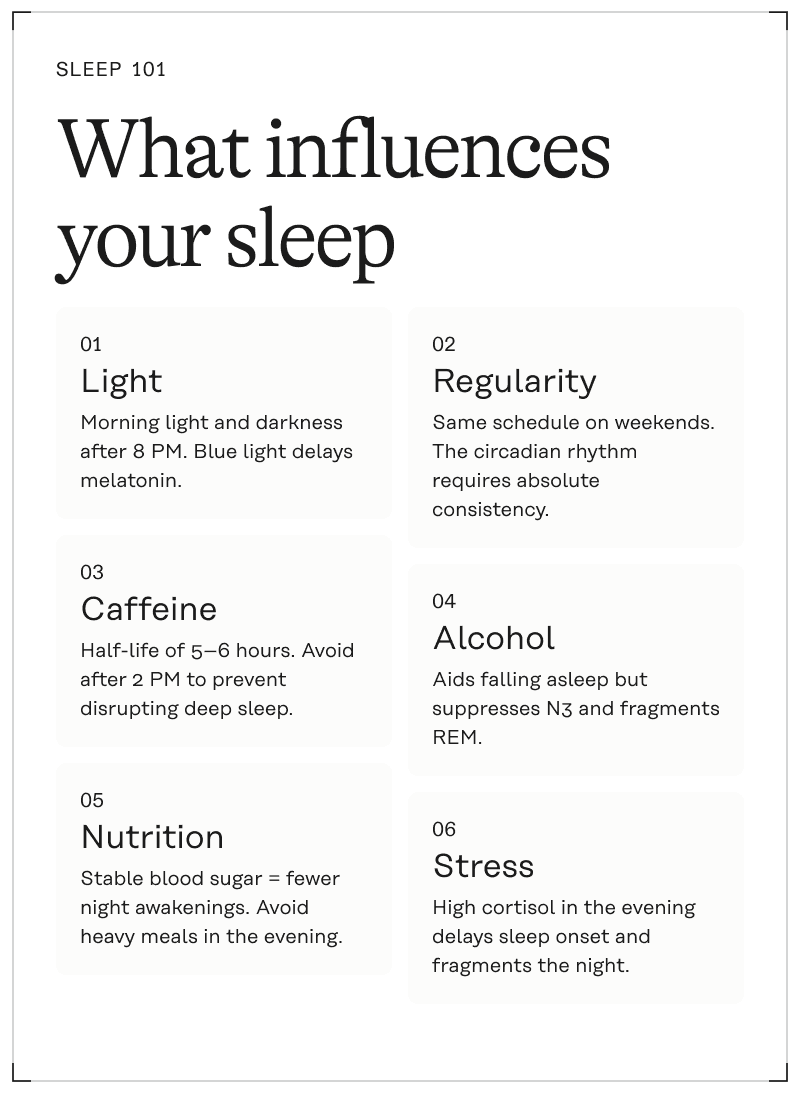
1. Light
Light is one of the most powerful signals for setting the biological clock. Morning natural light helps synchronize the circadian rhythm and strengthen wakefulness. In the evening, however, bright or blue light can delay the nighttime signal and disrupt melatonin.
2. Regularity
Sleep likes predictability. Highly variable schedules, especially between weekdays and weekends, can create a form of jet lag. The body has to constantly readapt, which can disrupt sleep onset, morning energy, and recovery. Regularity does not mean absolute rigidity. But relatively stable bedtimes and wake times are often more important than we think. Ideally, a maximum 30-minute gap is desirable.
3. Caffeine
Caffeine blocks adenosine receptors, and adenosine is one of the molecules involved in sleep pressure. Even if you feel like you sleep well after a late coffee, sleep quality may be altered: lighter sleep, delayed sleep onset, and reduced deep sleep in some people. Sensitivity varies greatly from one person to another. But for people who sleep poorly, caffeine after early afternoon is often worth questioning.
4. Alcohol
Alcohol can give the impression that it helps you fall asleep, but it disrupts sleep architecture. It can fragment the night, reduce REM sleep quality, increase nighttime awakenings, and worsen breathing-related sleep issues in some people. Falling asleep faster does not always mean sleeping better.
5. Nutrition and blood sugar
Sleep and nutrition are deeply connected. A very heavy, very late, or difficult-to-digest dinner can disrupt sleep onset and promote nighttime awakenings.
Conversely, insufficient intake during the day, meals that are too low in carbohydrates for some active people, or unstable blood sugar can also contribute to nighttime awakenings. Intake of protein, quality carbohydrates, magnesium, vitamin D, B vitamins, omega-3s, and iron may also play a role.
6. Stress and mental load
Stress does not only disrupt sleep onset. It can alter sleep architecture. When the nervous system remains vigilant, the body may struggle to enter deep, stable sleep. This can create a very common pattern: significant fatigue, but an inability to switch off. The body is exhausted, but the alert system remains active.
7. Sex hormones
In women, hormonal fluctuations can influence sleep. In the premenstrual phase, some women sleep less well: higher body temperature, PMS, pain, anxiety, nighttime awakenings, breast tenderness, migraines, or digestive discomfort.
In perimenopause, fluctuations followed by the gradual decline of estrogen and progesterone can promote nighttime awakenings, night sweats, hot flashes, nighttime anxiety, or more fragmented sleep.
In these situations, sleep cannot be separated from the hormonal, metabolic, and nervous system context.
What biomarkers can reveal
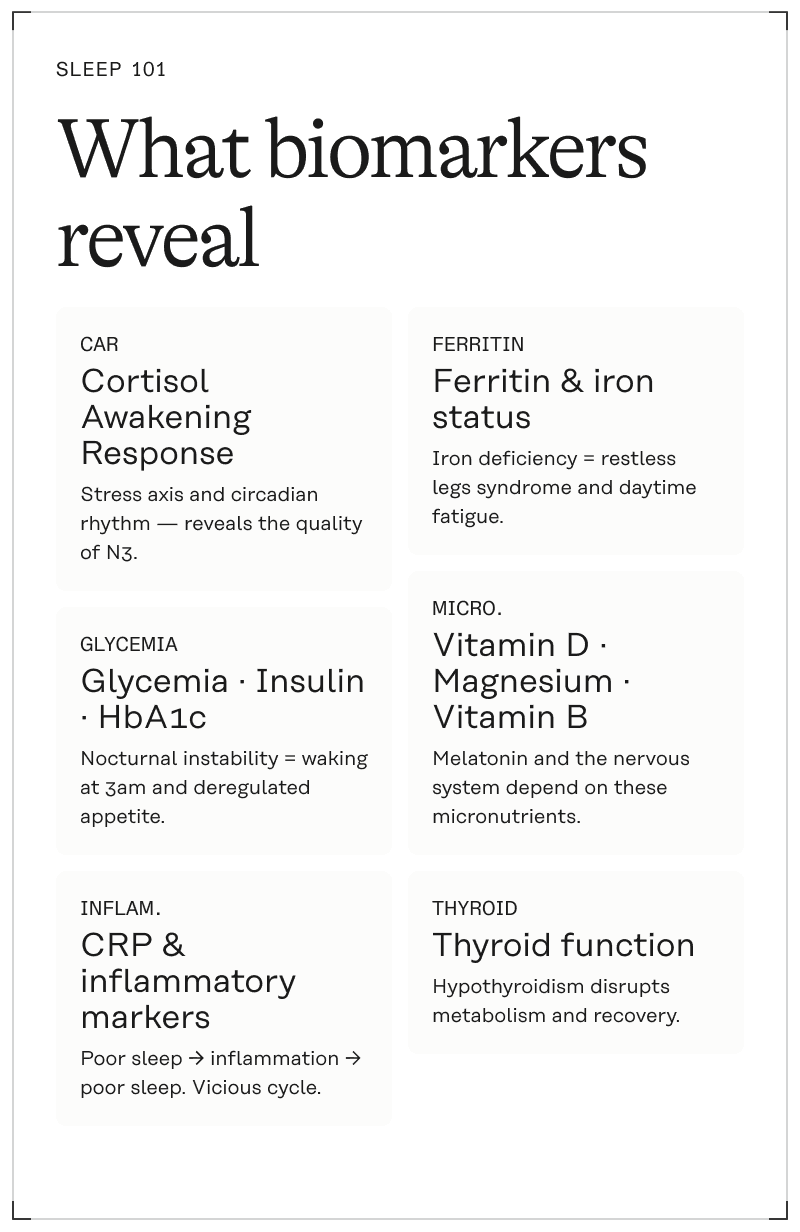
With a comprehensive blood panel, sleep can be placed within a broader context: metabolic, inflammatory, hormonal, micronutritional, and nervous system-related. The goal is to better understand the terrain that may contribute to fragmented sleep, fatigue upon waking, nighttime awakenings, or insufficient recovery.
Certain markers can help explore:
Cortisol Awakening Response (CAR): to assess the cortisol response upon waking and better understand the rhythm of the stress axis.
Blood glucose, insulin, and HbA1c: to identify blood sugar instability that may contribute to nighttime awakenings, cravings, or morning fatigue.
CRP and inflammatory markers: to identify an inflammatory terrain that may maintain fatigue, pain, slow recovery, or less restorative sleep.
Ferritin and iron status: especially in cases of persistent fatigue, restless legs, shortness of breath, heavy periods, or difficult recovery.
Vitamin D, magnesium, and certain B vitamins: involved in nervous system, muscle, and immune function, as well as the synthesis of certain neurotransmitters.
Thyroid function: because thyroid imbalance can influence energy, body temperature, heart rate, anxiety, fatigue, and sometimes sleep.
At Lucis, biomarker analysis helps connect your symptoms to your biological terrain, so you can better understand what may be disrupting your energy, recovery, and sleep quality.
Sleep is a signal
Your sleep reflects the state of your nervous system, circadian rhythm, blood sugar regulation, inflammation, hormones, environment, and overall recovery. Understanding what happens upstream helps identify the levers that are truly relevant to you.
Sleep is one of the most powerful levers to restore when the goal is to improve energy, mental clarity, hormonal health, metabolism, and recovery.
🎧 Go further: a special sleep episode on the Lucis podcast
Brain fog, chronic fatigue, irritability, anxiety, weight gain. Lack of sleep silently wears down the body. Yet we are never taught how to sleep.
Aurélie Montin, a French sleep specialist, spent 15 years in severe insomnia, all the way to burnout. She rebuilt everything: nutrition, microbiome, emotional hygiene, biological panels. Today, with her "Connexion Sommeil" method, she helps hundreds of people reconnect with their nights.
In this episode, we cover the real causes of poor sleep (no, it is not blue light), the gut-brain connection, chronotypes, the ideal day from morning to evening, early dinners, trackers (Whoop, Apple Watch), alcohol, invisible deficiencies, and most importantly: where to start when you have been sleeping badly for years. (Episode in French.)
References
The information shared in this article is provided for educational purposes only. It does not replace medical advice, diagnosis, or care from a qualified healthcare professional.
Chang AM, et al. (2015). Evening use of light-emitting eReaders negatively affects sleep, circadian timing, and next-morning alertness. PNAS 112(4):1232-1237.
Irwin MR. (2015). Why sleep is important for health: a psychoneuroimmunology perspective. Annual Review of Psychology 66:143-172.
Stenholm S, et al. (2019). Sleep Duration and Sleep Disturbances as Predictors of Healthy and Chronic Disease-Free Life Expectancy. Journals of Gerontology: Series A 74(2):204-210.
Van Cauter E, et al. (1998). Interrelations between sleep and the somatotropic axis. Sleep 21(6):553-566.
Xie L, et al. (2013). Sleep drives metabolite clearance from the adult brain. Science 342(6156):373-377.
Written by Anaïs Gautron
More insights, straight to your inbox.
New articles on biomarkers, performance, and wellness. No noise, just substance.