
Allergies 1/2: what's really happening in the body
What an allergy really is and the terrain that shapes its intensity.
Table of contents
📌 This is Part 1 of our two-part series on allergies. In Part 2, we look at the concrete levers that support the biological terrain and help reduce symptoms.
Allergies are not simply "a reaction to pollen." They represent a specific immune response, in which the body identifies a normally harmless substance (pollen, mould, dust mites) as a threat.
From there, a cascade unfolds: the system produces IgE, antibodies directed against the allergen; these IgE activate mast cells, immune cells present in the mucous membranes; those mast cells then release histamine and other inflammatory mediators. This reaction drives mucosal inflammation, respiratory and ocular symptoms, and sometimes a more diffuse fatigue.
The severity of symptoms also depends on the biological context in which this reaction occurs: mucosal health, baseline inflammation, gut microbiome, histamine load, nutritional status, sleep, stress, environmental exposure, and sometimes hormonal fluctuations.
The goal of this first part is straightforward: understand what an allergy is, what triggers the reaction, what amplifies it, and why some people develop more intense or more persistent symptoms.
1. An allergy is not a "weak immune system"
An allergy is not a sign of a weak immune system. It is rather a maladaptive immune response: the body reacts against a substance that is not, in itself, dangerous.
In the case of seasonal allergies, the most common triggers are:
Tree pollens: birch, cypress, plane tree, olive.
Grass pollens: grasses, cereals, hay.
Weed pollens: ragweed, mugwort.
Moulds: spores found in outdoor or indoor air.
Dust mites: most commonly Dermatophagoides pteronyssinus and Dermatophagoides farinae.
In an allergic individual, the immune system identifies these particles as threats and triggers a defensive response. That response is what produces the symptoms.
2. The core mechanism
Most allergies are based on what is called an IgE-mediated reaction. IgE are antibodies produced by the immune system against a specific allergen. The mechanism unfolds in two stages.
First stage: sensitisation
Upon first contact with an allergen, the immune system may produce IgE antibodies specific to that allergen. These IgE then bind to the surface of certain immune cells, primarily mast cells.
At this stage, there are not necessarily any symptoms. The system is simply primed.
Second stage: the allergic reaction
Upon re-exposure to the same allergen, it binds to the IgE already sitting on mast cells. This triggers their activation. The mast cells then release several inflammatory mediators, the most well-known of which is histamine.
Histamine: itching, sneezing, runny nose, redness, irritation.
Prostaglandins: local inflammation, congestion, vasodilation.
Leukotrienes: mucus production, congestion, bronchoconstriction in some profiles.
Cytokines: amplification of the immune response.
This cascade explains the classic symptoms: runny nose, sneezing, red eyes, irritated throat, congested sinuses. It also explains why some people experience significant fatigue: an allergic reaction is not only local, it mobilises the immune system as a whole.
3. Why symptoms can last hours or days
The allergic reaction often has two phases.
Frame 1.png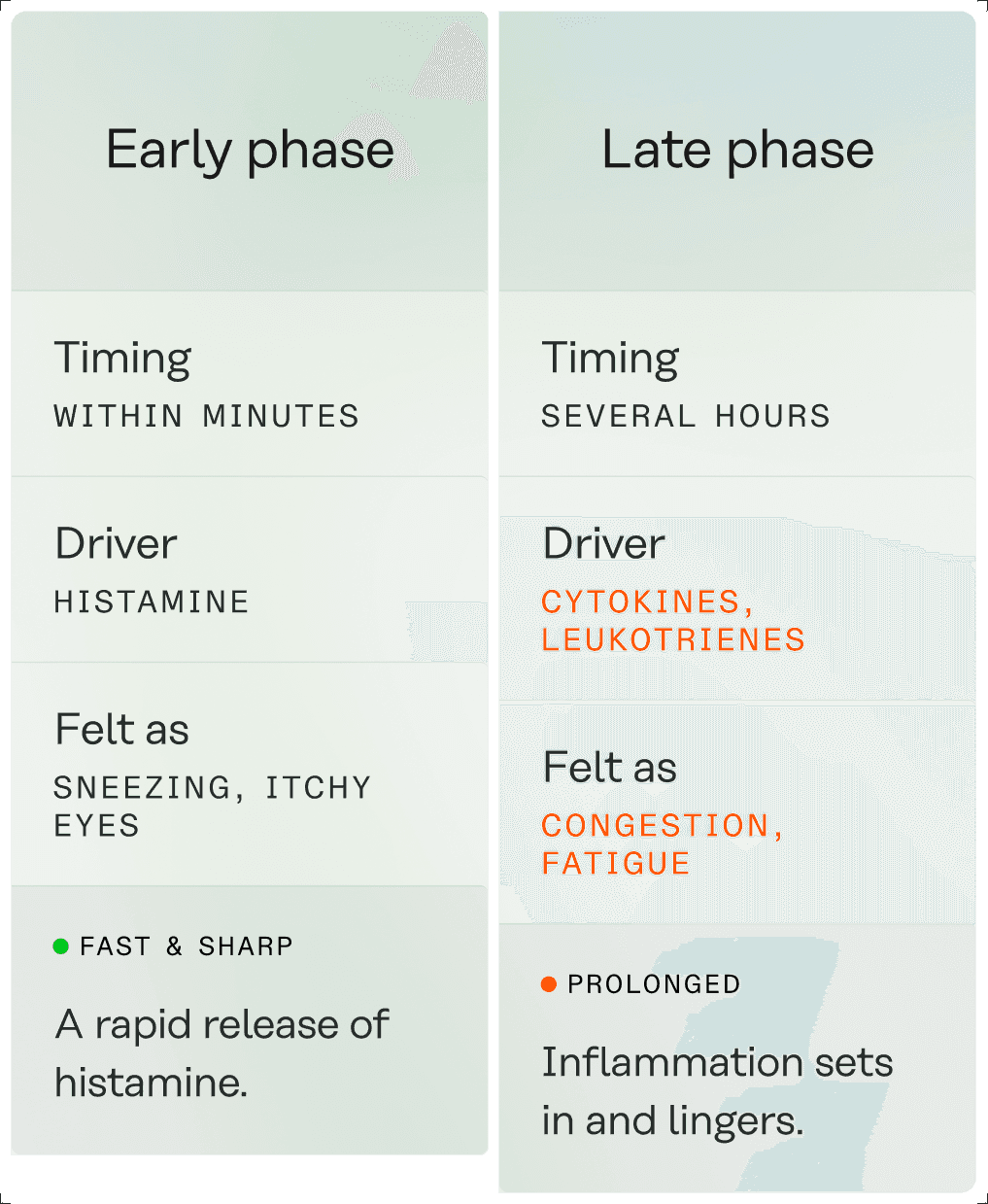
Early phase (within minutes of exposure): sneezing, itching, rhinorrhoea, stinging eyes.
Late phase (several hours later): congestion, persistent inflammation, fatigue, heavy sinuses.
The early phase is primarily driven by the rapid release of histamine. The late phase involves cytokines, leukotrienes, and eosinophils to a greater extent. This is what can create the feeling of being "inflamed", fatigued, and congested, even hours after the initial exposure has passed.
It is also why some people have few immediate symptoms but chronic congestion throughout the entire season.
4. The main drivers of allergies
There is no single cause. Allergies generally emerge when an immune predisposition meets an environment conducive to sensitisation.
EN_Allergies_terrain.png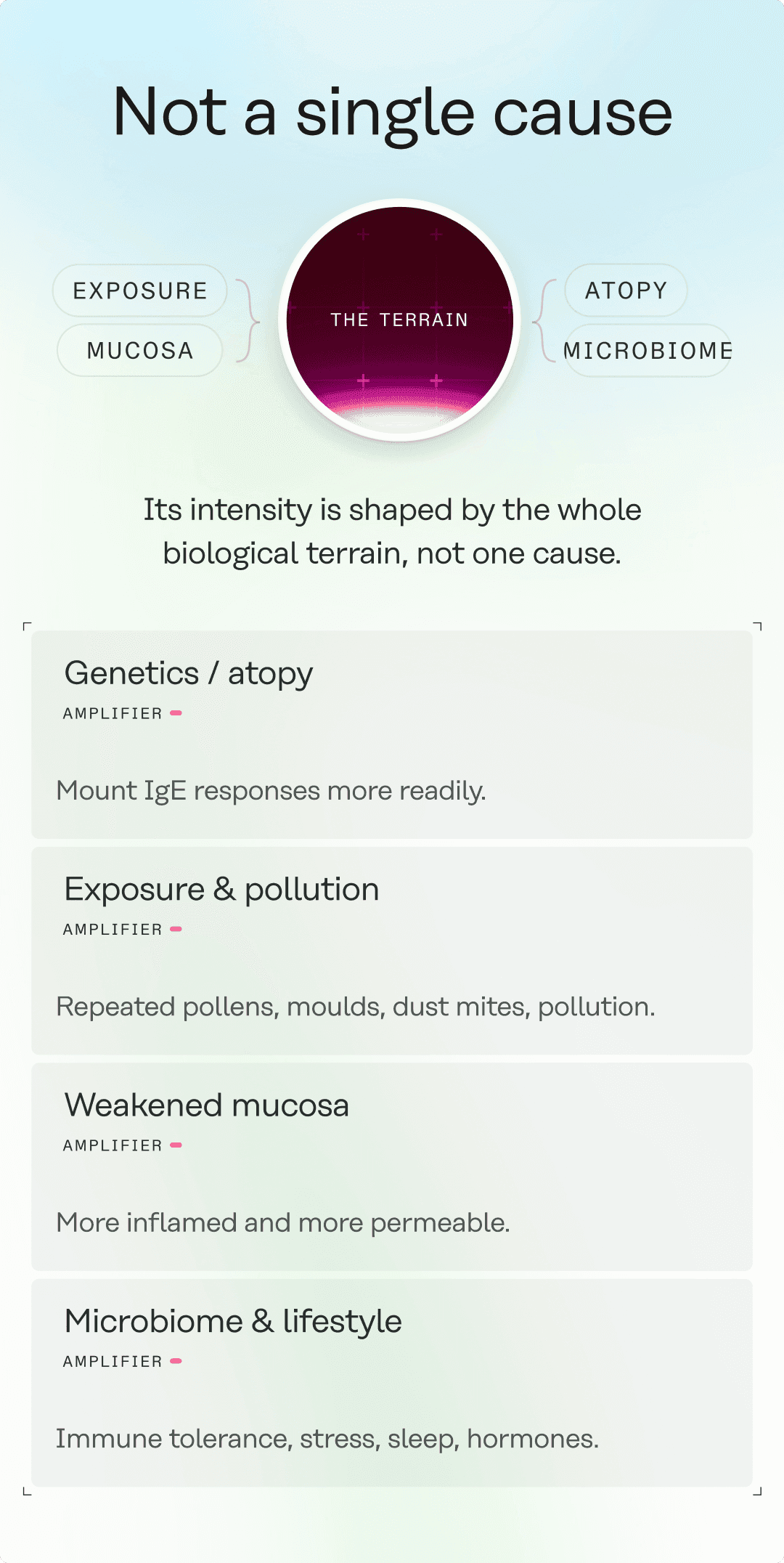
Genetics / atopic profile: some individuals more readily mount IgE responses.
Repeated allergen exposure: pollens, moulds, dust mites, pollution.
Impaired mucosal barrier: nasal or respiratory mucosa that is more inflamed, more permeable.
Air pollution: can make pollens more irritating and weaken the airways.
Gut microbiome: influences immune tolerance and inflammatory balance.
Low-grade inflammation: can amplify the allergic response.
Nutritional status: vitamin D, omega-3s, antioxidants, certain cofactors can modulate the biological terrain.
Stress / sleep: modulate immunity, inflammation, and mast cell reactivity.
Hormones: in some women, hormonal fluctuations can amplify histamine-related symptoms.
In other words: allergy is rooted in a specific immune response, but its intensity is shaped by the broader biological context.
5. Histamine: why it takes up so much space
Histamine is one of the central mediators of allergic symptoms. It is released by mast cells during an allergic reaction, but it can also come from other sources: food, intestinal bacterial production, inflammation, stress, and immune activation.
Histamine degradation depends in particular on an intestinal enzyme called DAO (diamine oxidase), whose activity can vary depending on gut health, genetics, and nutritional status. A DAO deficiency or reduced enzyme activity prevents efficient degradation, leading to histamine accumulation and triggering intolerance symptoms (headaches, digestive issues, skin reactions). This enzyme acts primarily in the small intestine, while another enzyme, HNMT (histamine N-methyltransferase), handles intracellular histamine degradation in the tissues.
A high histamine load can contribute to symptoms that extend well beyond simple rhinitis.
Nose / sinuses: runny nose, congestion, sneezing.
Eyes: itching, redness, watering.
Skin: flushing, itching, hives.
Digestion: bloating, diarrhoea, discomfort after fermented foods.
Nervous system: headaches, migraines, restlessness, disrupted sleep.
Hormonal cycle: symptoms sometimes more pronounced before menstruation or in perimenopause.
This does not mean that all allergies are "histamine intolerances." But in certain profiles, the total histamine load can amplify symptoms. This is particularly relevant when the following are present:
significant allergies;
migraines;
flushing;
hives;
reactions to wine, fermented foods, or aged cheeses;
associated digestive symptoms;
cyclical worsening in women.
6. The role of the mucous membranes
Seasonal allergies primarily affect the mucous membranes: nose, sinuses, eyes, bronchi. These membranes are not simply passive surfaces. They form an active barrier between the external environment and the immune system.
When they are irritated, dry, inflamed, or exposed to pollution, they can become more reactive.
Pollution: irritation, oxidative stress, local inflammation.
Dry air: more sensitive mucosa, nasal discomfort.
Repeated infections: persistent inflammation.
Tobacco / irritants: increased respiratory reactivity.
Reflux: possible chronic ENT irritation.
Nutritional deficiencies: mucosal barrier less well supported.
7. The gut-immunity connection
The gut plays a major role in immune regulation. It houses a large proportion of immune cells and maintains constant dialogue with the microbiome.
The microbiome participates in the education of the immune system: it influences tolerance, inflammation, the production of anti-inflammatory metabolites, and the integrity of the intestinal barrier.
Several studies examining allergic conditions show associations between dysbiosis, reduced microbial diversity, and dysregulation of the immune response. This means the gut can contribute to the allergic terrain through several mechanisms:
Production of short-chain fatty acids: support of immune tolerance and intestinal barrier integrity.
Microbial diversity: greater immune resilience.
Histamine-producing bacteria: potentially higher histamine load.
Digestive inflammation: background immune activation.
Impaired intestinal barrier: potentially increased systemic reactivity.
When allergies are chronic and associated with digestive symptoms, it is relevant to also assess the gut terrain.
8. Hormones: a possible amplifier in some women
In some women, allergic or histamine-related symptoms vary with the menstrual cycle. They may be more pronounced before menstruation, around ovulation, during perimenopause, and during significant hormonal fluctuations.
Mast cells interact with sex hormones. Oestrogens can increase mast cell reactivity in certain profiles, while histamine can also interact with the hormonal axis. Progesterone, on the other hand, has an antagonistic effect on mast cells and supports DAO activity. Its decline in the late luteal phase and during perimenopause helps explain the worsening of histamine-related symptoms during these windows.
This does not mean that hormones are "the cause" of allergies. But they can amplify an already reactive terrain.
9. Useful biomarkers
Not everyone with straightforward allergies requires testing. But when symptoms are significant, persistent, atypical, or resistant to standard measures, certain markers can help characterise the biological terrain.
Frame 377.png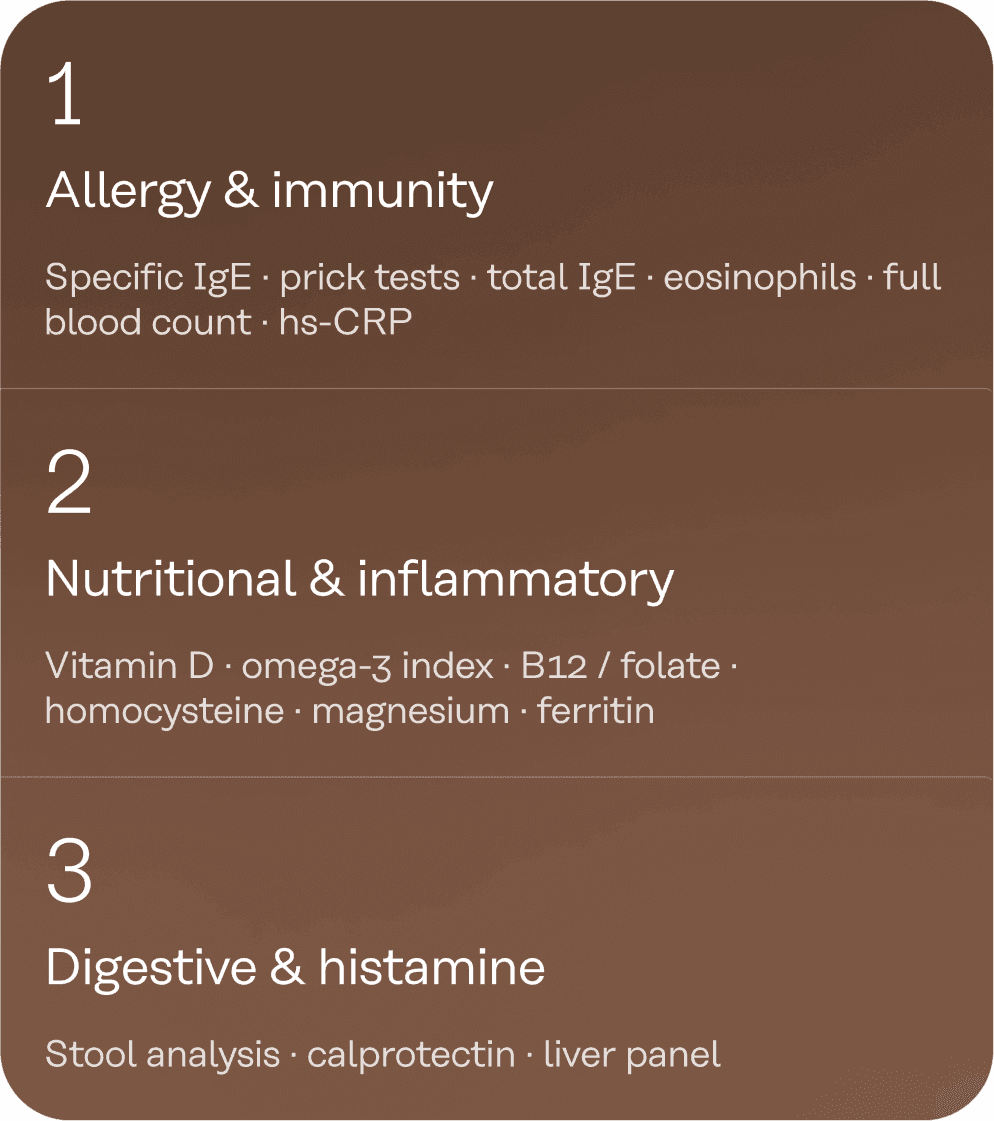
Allergy and immunity
Specific IgE: identify the allergens involved.
Prick tests: confirm clinically relevant sensitisation.
Total IgE: assess global atopic terrain (low specificity).
Eosinophils: possible marker of allergic inflammation.
Full blood count: global immune system overview.
hs-CRP: low-grade systemic inflammation, can be normal despite active allergies.
Nutritional and inflammatory terrain
Vitamin D: immune regulation, inflammatory terrain.
Omega-3 index: pro- vs. anti-inflammatory lipid balance.
B12 / folate: support of methylation pathways.
Homocysteine: indirect marker of B12 / folate / B6 status.
Magnesium: relevant when stress, disrupted sleep, or migraines are present.
Ferritin: fatigue, inflammation, overall terrain.
Digestive / histamine terrain (context-dependent)
Stool analysis: if associated digestive symptoms, suspected dysbiosis.
Calprotectin: if inflammatory digestive signs are present.
Liver panel: broader context, medication use, fatigue, medical history.
The goal is to distinguish a straightforward allergy from a more reactive, more inflammatory, or more histamine-driven terrain.
Conclusion
Allergies are immune reactions. They typically involve IgE sensitisation, mast cell activation, histamine release, and mucosal inflammation.
But their intensity depends on several factors: allergen exposure, mucosal health, pollution, baseline inflammation, gut microbiome, histamine load, nutritional status, sleep, stress, and sometimes hormonal fluctuations.
Understanding these mechanisms helps avoid two common mistakes: assuming that allergies are entirely a genetic inevitability, and assuming that they can be resolved by a single supplement or a single dietary exclusion.
The reality is more nuanced, and more interesting: there is an identifiable allergic reaction, but also a biological terrain that can amplify or attenuate it. In Part 2, we will look at the concrete levers that support the terrain and reduce symptoms.
The information in this article is provided for educational purposes only and does not constitute medical advice, diagnosis, or treatment. Always consult a qualified healthcare professional before making changes to your diet, supplementation, or medical care. Lucis is not a medical device.
Scientific references
Bousquet J, Schünemann HJ, Togias A, et al. Next-generation Allergic Rhinitis and Its Impact on Asthma (ARIA) guidelines. Journal of Allergy and Clinical Immunology. 2020;145(1):70–80.e3.
Comas-Basté O, Sánchez-Pérez S, Veciana-Nogués MT, Latorre-Moratalla ML, Vidal-Carou MC. Histamine intolerance: the current state of the art. Biomolecules. 2020;10(8):1181.
Folkerts J, Stadhouders R, Redegeld FA, et al. Effect of dietary fiber and metabolites on mast cell activation and mast cell-associated diseases. Frontiers in Immunology. 2018;9:1067.
Galli SJ, Tsai M, Piliponsky AM. The development of allergic inflammation. Nature. 2008;454(7203):445–454.
Maintz L, Novak N. Histamine and histamine intolerance. American Journal of Clinical Nutrition. 2007;85(5):1185–1196.
Naclerio RM, Proud D, Togias AG, et al. Inflammatory mediators in late antigen-induced rhinitis. New England Journal of Medicine. 1985;313(2):65–70.
Reinholz M, Ruzicka T, Schauber J. Vitamin D and its role in allergic disease. Clinical and Experimental Allergy. 2012;42(6):817–826.
Stone KD, Prussin C, Metcalfe DD. IgE, mast cells, basophils, and eosinophils. Journal of Allergy and Clinical Immunology. 2010;125(2 Suppl 2):S73–S80.
Watts AM, West NP, Zhang P, et al. The gut microbiome of adults with allergic rhinitis is characterised by reduced diversity and an altered abundance of key microbial taxa compared to controls. International Archives of Allergy and Immunology. 2021;182(2):94–105.
Zierau O, Zenclussen AC, Jensen F. Role of female sex hormones, estradiol and progesterone, in mast cell behavior. Frontiers in Immunology. 2012;3:169.
Written by Anaïs Gautron
More insights, straight to your inbox.
New articles on biomarkers, performance, and wellness. No noise, just substance.