Love and social connection are therapeutic: Part 2
When connection protects: the biological cascades of safety
Table of contents
In Part 1, we saw how social isolation and toxic relationships activate biological cascades that weaken health: chronic inflammation, cortisol dysregulation, depletion of adaptive reserves.
This week, we explore the opposite.
How stable, secure, and mutually supportive relationships activate protective neurochemical cascades that support your long-term health.
Because the quality of your relationships doesn't just determine your emotional well-being.
It determines your health trajectory.
EN_2_Love_is_medecine_1.png
Social connection: a biological safety signal
When your brain perceives that you are surrounded, supported, safe, it sends a powerful signal throughout your body:
"We can invest in repair and regeneration, instead of staying in defense mode."
This transition translates into measurable changes:
✅ Cortisol reduction
✅ Decreased inflammation
✅ Improved recovery
✅ More balanced immune modulation
The 3 protective cascades
1. Oxytocin: the repair hormone
Oxytocin is a hormone produced by the hypothalamus and released during safe physical and emotional contact: hugs, deep conversations, shared meals, sexual activity.
Its biological role:
Oxytocin acts directly on several systems:
Stress axis: reduces the release of CRH and ACTH, thus decreasing cortisol production
Cardiovascular system: lowers blood pressure and heart rate
Immune system: modulates inflammation via receptors on immune cells
Nervous system: activates the vagus nerve and promotes "rest & digest" mode
What research has measured:
EN_2_Love_is_medecine_2.png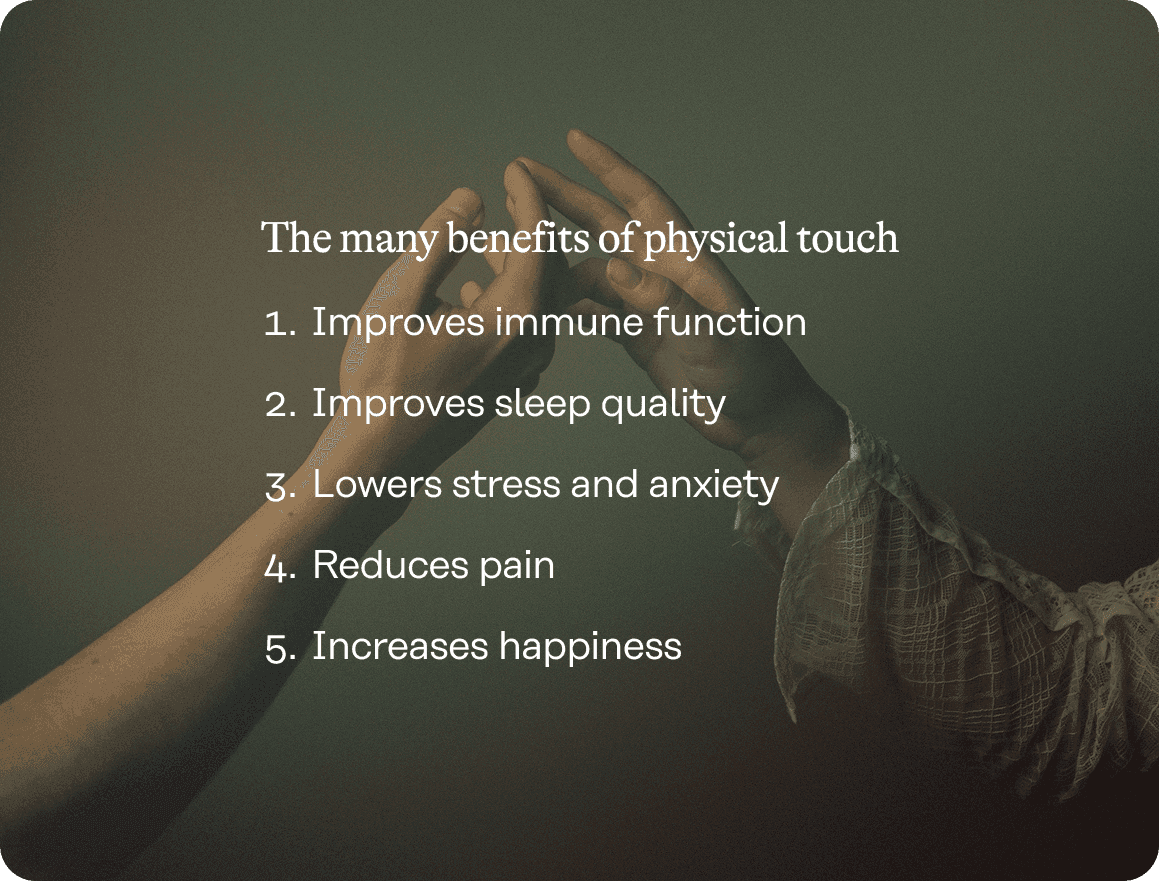
Research on over 12,000 participants shows that safe physical contact (hugs, massage, affective touch) produces:
Cortisol reduction
Pain reduction (moderate to strong effect)
Reduction in anxiety and depression (moderate effect)
Improved wound healing
Key principle: short, repeated sessions are more effective than long, occasional ones.
The simple gesture: 1 hug of 20 seconds per day (partner, child, close friend, pet).
2. Immune modulation: exiting "chronic defense" mode
Healthy relationships modify the gene expression of your immune cells.
What research shows:
People living in stable and supportive relationships show:
Less expression of pro-inflammatory genes
More expression of genes linked to antiviral defense and cellular repair
Better immune response
The longevity effect:
This "balanced" immune profile is associated, in multi-decade follow-ups, with:
Reduced cardiovascular risk
Lower risk of chronic inflammatory diseases
More favorable aging trajectories
Key principle: your immune system responds in real time to your social environment. More relational security = more repair, less chronic defense.
3. Relationships as a longevity factor: population data
EN_2_Love_is_medecine_3.png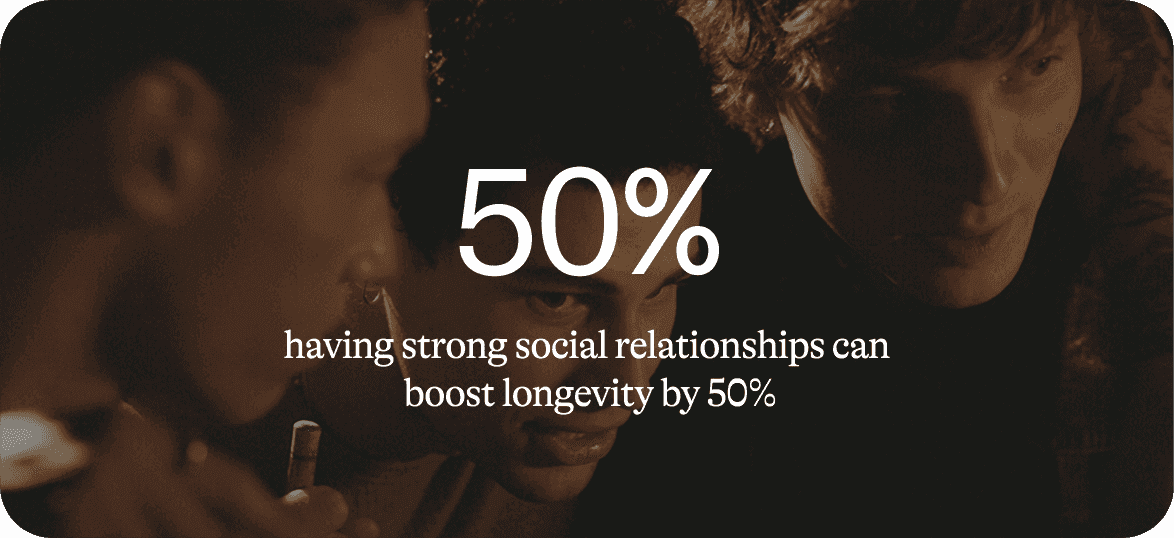
Systematic reviews of over 300,000 participants followed for several decades show that:
People with strong, supportive social relationships have:
50% reduced risk of all-cause mortality vs. isolated individuals
Reduced cardiovascular risk (effect comparable to quitting smoking)
Better recovery after health events (stroke, heart attack, surgery)
The effect is dose-dependent: the more diverse, stable, and mutually supportive your relationships, the stronger the protective effect.
Blue Zones: longevity through connection
In the 5 Blue Zones (regions where centenarians live healthier, longer), one absolute commonality: the quality of social bonds.
Moai (Okinawa): lifelong friendship circles, predictable mutual support
Daily family meals (Sardinia, Ikaria): multiple generations at the table
Multigenerational integration: elders remain active, connected, useful
Meaningful social roles: belonging, utility, transmission
Result: 10x more centenarians, fewer chronic diseases, active and autonomous life until 90+ years.
The nuance: Blue Zones combine multiple factors (diet, activity, low stress, community). Impossible to isolate the effect of relationships alone, but their systematic presence across these 5 zones suggests they constitute an essential pillar of longevity.
How to build your "relational ecology"
1. Identify your 3 nourishing connections
People with whom you feel safe, heard, supported without judgment.
→ These are your biological refuges.
2. Make these interactions predictable
3 recurring moments per week:
Monday 6pm: call with a friend
Thursday noon: shared lunch (no screens)
Sunday morning: walk or family breakfast
→ Predictability is essential: your brain needs to know the support is reliable.
3. Integrate affective touch (if context is safe)
20-second hug daily
Regular light physical contact
Short repeated sessions > long occasional sessions
4. Diversify your connections
Deep bonds (1-3 people of absolute trust)
Reciprocal bonds (friendships, colleagues, neighbors)
Community bonds (clubs, associations, interest groups)
→ Diversity protects: if one bond weakens, others compensate.
5. Prioritize shared meals
At least 3 shared meals per week (no screens).
What to remember
EN_2_Love_is_medecine_4.png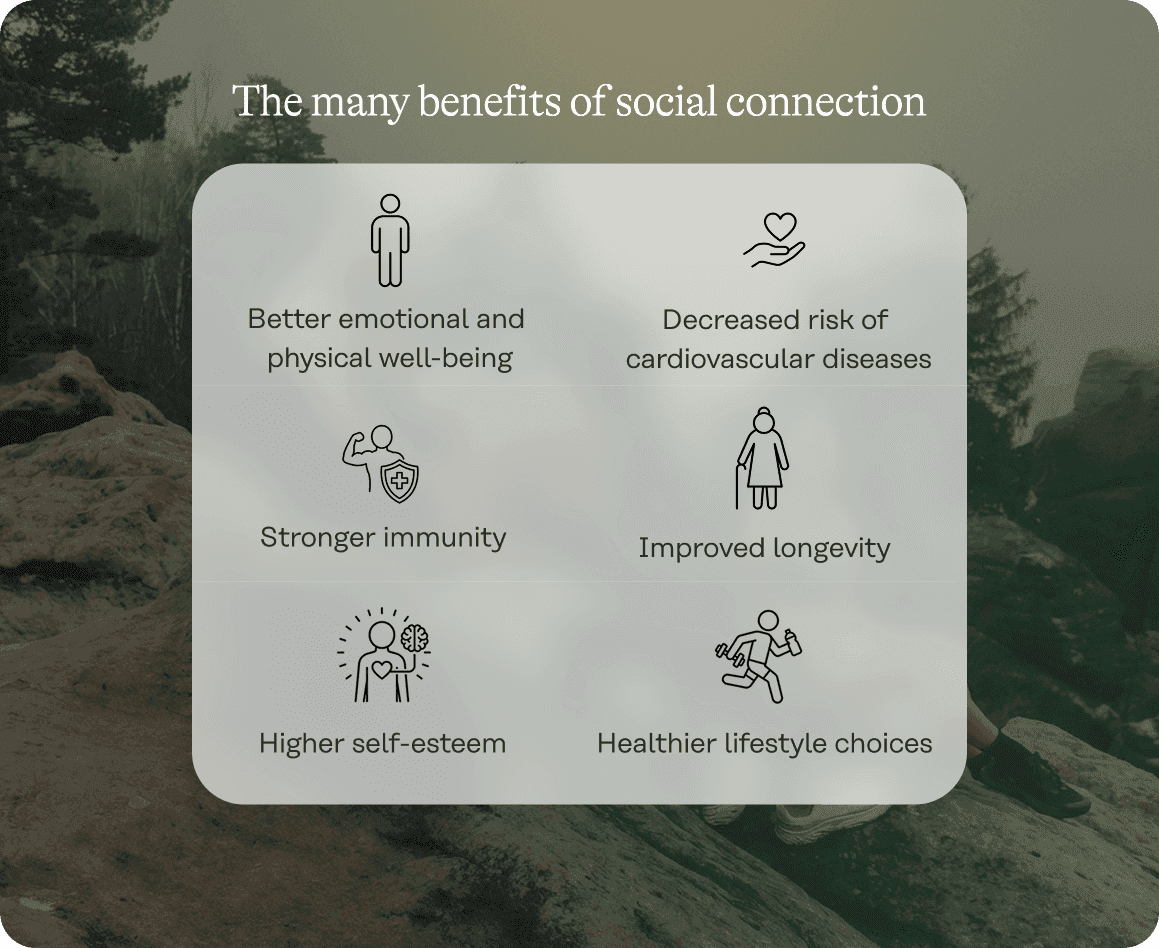
Stable, predictable, and mutually supportive relational bonds activate measurable protective biological cascades:
Cortisol reduction via oxytocin
Inflammation modulation (more balanced immune profile)
50% reduction in all-cause mortality risk
The most documented levers:
3 recurring social interactions per week (predictable)
Shared meals (at least 3x/week, no screens)
Short, repeated affective touch (20 seconds/day, safe context)
Diversity of bonds (deep + reciprocal + community)
Relational ecology is not a "nice-to-have."
It's a health infrastructure.
Want to measure the impact on your biology?
At Lucis, the goal is to make visible what is often invisible: how your environment (stress, sleep, habits, recovery, and yes, also relational context) can be reflected in key long-term health markers.
👉 Book your Lucis assessment here
This content is provided for informational and educational purposes. It does not replace medical advice, diagnosis, or psychological follow-up.
Ressources
Cole, S. W. (2019). The conserved transcriptional response to adversity. Current Opinion in Behavioral Sciences, 28, 31–37. https://doi.org/10.1016/j.cobeha.2019.01.008
De Vogli, R., Chandola, T., & Marmot, M. G. (2007). Negative aspects of close relationships and heart disease. Archives of Internal Medicine, 167(18), 1951–1957. https://doi.org/10.1001/archinte.167.18.1951
Glass, L. (1995). Toxic People: 10 Ways of Dealing with People Who Make Your Life Miserable. Simon & Schuster.
Holt-Lunstad, J., Smith, T. B., Baker, M., Harris, T., & Stephenson, D. (2015). Loneliness and social isolation as risk factors for mortality: A meta-analytic review. Perspectives on Psychological Science, 10(2), 227–237. https://doi.org/10.1177/1745691614568352
Holt-Lunstad, J., Smith, T. B., & Layton, J. B. (2010). Social relationships and mortality risk: A meta-analytic review. PLOS Medicine, 7(7), e1000316. https://doi.org/10.1371/journal.pmed.1000316
Kuiper, J. S., Zuidersma, M., Oude Voshaar, R. C., Zuidema, S. U., van den Heuvel, E. R., Stolk, R. P., & Smidt, N. (2015). Social relationships and risk of dementia: A systematic review and meta-analysis of longitudinal cohort studies. Ageing Research Reviews, 22, 39–57. https://doi.org/10.1016/j.arr.2015.04.006
Luo, Y., Hawkley, L. C., Waite, L. J., & Cacioppo, J. T. (2012). Loneliness, health, and mortality in old age: A national longitudinal study. Social Science & Medicine, 74(6), 907–914. https://doi.org/10.1016/j.socscimed.2011.11.028
Marmot, M. G., Smith, G. D., Stansfeld, S., Patel, C., North, F., Head, J., White, I., Brunner, E., & Feeney, A. (1991). Health inequalities among British civil servants: The Whitehall II study. The Lancet, 337(8754), 1387–1393. https://doi.org/10.1016/0140-6736(91)93068-K
Rook, K. S. (2015). Social networks in later life: Weighing positive and negative effects on health and well-being. Current Directions in Psychological Science, 24(1), 45–51. https://doi.org/10.1177/0963721414551364
Shen, C., et al. (2025). Plasma proteomic signatures of social isolation and loneliness. Nature Human Behaviour. Advance online publication. https://doi.org/10.1038/s41562-024-02078-1
Steptoe, A., Shankar, A., Demakakos, P., & Wardle, J. (2013). Social isolation, loneliness, and all-cause mortality in older men and women. Proceedings of the National Academy of Sciences, 110(15), 5797–5801. https://doi.org/10.1073/pnas.1219686110
Valtorta, N. K., Kanaan, M., Gilbody, S., & Hanratty, B. (2018). Loneliness, social isolation and risk of cardiovascular disease in the English Longitudinal Study of Ageing. European Journal of Preventive Cardiology, 25(13), 1387–1396. https://doi.org/10.1177/2047487318792696
Valtorta, N. K., Kanaan, M., Gilbody, S., Ronzi, S., & Hanratty, B. (2016). Loneliness and social isolation as risk factors for coronary heart disease and stroke: Systematic review and meta-analysis of longitudinal observational studies. Heart, 102(13), 1009–1016. https://doi.org/10.1136/heartjnl-2015-308790
Waldinger, R. J., & Schulz, M. S. (2010). What’s love got to do with it? Social functioning, perceived health, and daily happiness in married octogenarians. Psychology and Aging, 25(2), 422–431. https://doi.org/10.1037/a0019087
Waldinger, R. J., & Schulz, M. S. (2023). The Good Life: Lessons from the World’s Longest Scientific Study of Happiness. Simon & Schuster.
Wang, J., Mann, F., Lloyd-Evans, B., Ma, R., & Johnson, S. (2018). Associations between loneliness and perceived social support and outcomes of mental health problems: A systematic review. BMC Psychiatry, 18(1), 156. https://doi.org/10.1186/s12888-018-1736-5
Written by Anaïs Gautron
More insights, straight to your inbox.
New articles on biomarkers, performance, and wellness. No noise, just substance.