
Fertility 1/2: Understanding male fertility
Understanding the factors and levers to optimize male fertility
Table of contents
This is Part 1 of our 2-part series on fertility. Next week, we'll explore female fertility with the same approach.
When a couple struggles to conceive, the investigation often focuses first on the woman. Yet, in 50% of infertility cases, the male factor is involved.
And this is not marginal. A meta-analysis published in 2022 and released in 2023 reported a 51.6% decline in mean sperm concentration and a 62.3% decline in total sperm count between 1973 and 2018 among unselected men.
There are two main categories of causes:
On one hand, medical or structural causes that require specialized care: varicocele, erectile dysfunction, infections, obstructions of the vas deferens, genetic abnormalities, autoimmune disorders, etc. These situations must be evaluated by a qualified healthcare professional (urologist, andrologist).
On the other hand, modifiable factors related to lifestyle and environment: hormonal balance, inflammation, oxidative stress, nutritional deficiencies, exposure to endocrine disruptors.
This article focuses on these actionable levers. Because optimizing biological terrain is essential to support fertility.
We will explore what impairs male fertility, which biomarkers help evaluate it, and what concrete changes you can implement starting today.
The good news? Sperm renews every 72 to 90 days. Changes today, measurable results in 3 months.
What we measure: the sperm analysis
A sperm analysis evaluates several parameters:
Ejaculate volume: amount of semen released per ejaculation
Concentration: number of sperm per mL
Motility: ability to move effectively
Vitality: number of live sperm
Morphology: percentage of normal forms
An abnormal sperm analysis does not mean there's no room for improvement. It means you need to investigate further.
EN_1.png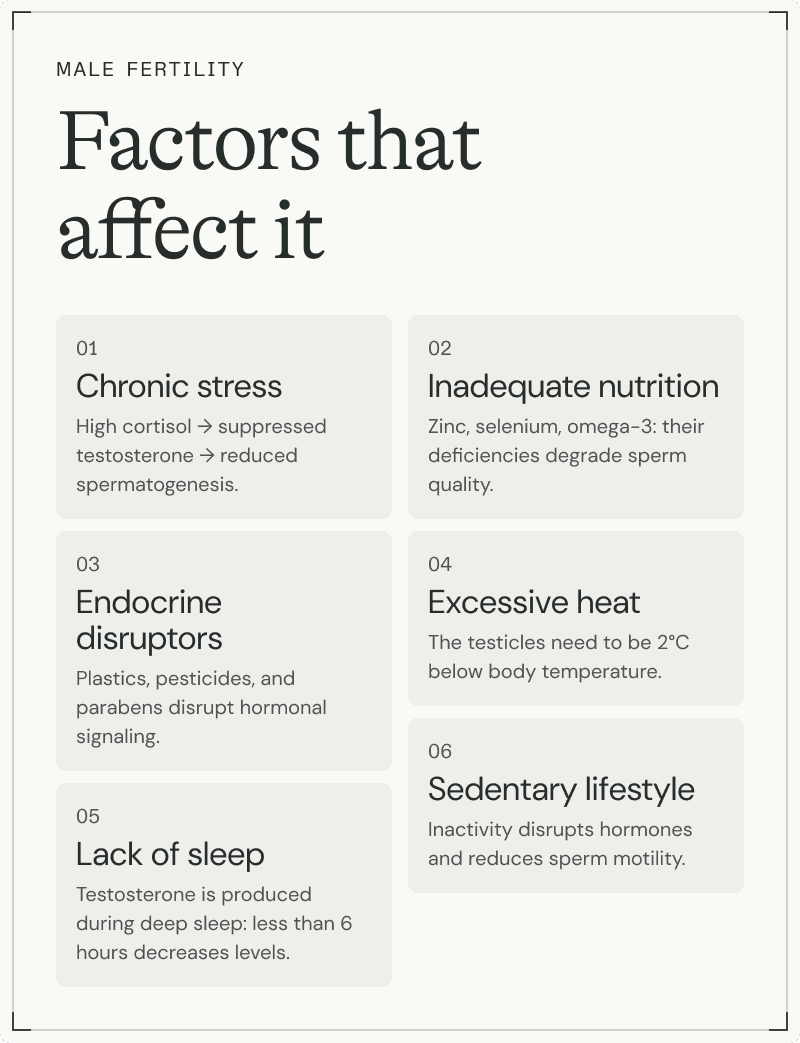
The key factors that impair male fertility
1. Hormonal imbalances
Male fertility depends on precise hormonal balance:
FSH: supports spermatogenesis (elevated = possible testicular failure)
LH: stimulates testosterone production
Testosterone (total and free): essential for spermatogenesis and libido
Estradiol: regulates (in small amounts) sperm maturation. If elevated: brake on the reproductive axis
Prolactin: elevated = brake on the reproductive axis
A fertility issue is not just a mechanical problem. It can reflect hormonal imbalance.
Lucis Biomarkers: Total/free testosterone, SHBG, FSH, LH, Prolactin, Estradiol.
2. Thyroid function
A disrupted thyroid, even subclinical, can impair sperm motility, concentration, and overall hormonal balance.
Consider testing if you experience: chronic fatigue, weight fluctuations, mood disorders, decreased libido, cold sensitivity, dry skin.
Lucis Biomarkers: TSH, Free T3, Free T4.
3. Oxidative stress
Sperm are particularly vulnerable to oxidative stress (excess free radicals).
Consequences: impaired motility, damage to cell membranes, sperm DNA fragmentation, overall quality decline.
Sources: smoking (cigarettes, cannabis), alcohol, pollution, diet poor in antioxidants, chronic inflammation, sleep deprivation, chronic stress, excessive heat.
Lucis Biomarkers: Cortisol (in chronic excess, inhibits the reproductive axis), Homocysteine (indirect marker of oxidative stress and B9/B12 deficiency).
4. Inflammation and metabolic health
Men with low sperm count are more likely to have overweight or obesity, insulin resistance, metabolic syndrome, low-grade inflammation, and dyslipidemia. Adipose tissue produces pro-inflammatory cytokines and converts testosterone into estradiol.
Lucis Biomarkers: High-sensitivity CRP, Fasting glucose, HbA1c, Lipid profile (cholesterol, LDL, HDL, triglycerides).
5. Nutritional deficiencies
The body cannot produce quality sperm without sufficient building blocks.
Essential nutrients:
Zinc: spermatogenesis, DNA structure, motility
Selenium: antioxidant, thyroid function
Magnesium: cortisol regulation, energy metabolism
Vitamin D: supports reproductive function, improves motility and morphology
Folate (B9) and B12: cell division, DNA synthesis
Omega-3 (EPA/DHA): sperm membrane, inflammation reduction
Lucis Biomarkers: Vitamin D (25-OH), Zinc, Magnesium, Ferritin, Homocysteine.
6. Environmental exposures
Endocrine disruptors interfere with the hormonal system by mimicking, blocking, or disrupting natural hormones.
Main disruptors:
BPA (Bisphenol A): food plastics, cans, receipts
Phthalates: cosmetics, synthetic fragrances, food packaging, soft plastic toys
Certain pesticides
PFAS (Per- and Polyfluoroalkyl Substances): non-stick cookware, fast-food packaging, waterproof textiles, some cosmetics
Other exposures to consider:
Occupational exposures (paints, solvents, heavy metals)
Repeated excessive heat (hot baths, saunas, laptop on lap, tight clothing, mobile phone in front pocket)
Data do not always establish direct causality for each isolated molecule. However, they clearly justify reducing overall toxic load during preconception.
EN_2.png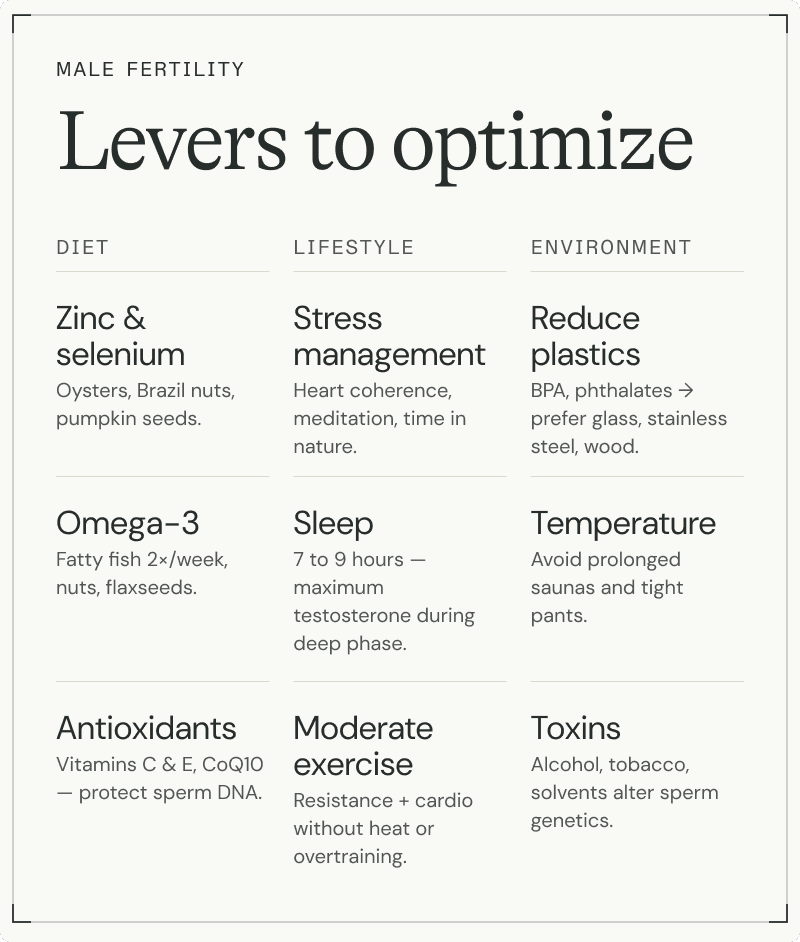
Actionable levers
Sperm renews every 72 to 90 days. By acting now on diet, lifestyle, and environment, you can observe measurable improvements in sperm quality within 3 months.
1. Nutrition
Favor:
Quality proteins: organic eggs, fatty fish, grass-fed meat, pasture-raised poultry
Cruciferous vegetables: broccoli, kale, Brussels sprouts
Antioxidants: berries, citrus fruits, peppers, spinach, tomatoes, pomegranate
Healthy fats: fatty fish, avocados, nuts, seeds, olive oil
Zinc: oysters, pumpkin seeds, eggs
Selenium: Brazil nuts (1/day)
Limit or avoid: refined sugars, ultra-processed foods, alcohol.
2. Lifestyle: optimize biological terrain
Sperm quality also depends on your daily lifestyle: sleep, physical activity, stress management, and heat exposure directly influence spermatogenesis.
Avoid excessive heat. Testicles must remain 2 to 3 °C below body temperature to produce quality sperm.
No prolonged hot baths or saunas
No laptop on lap
Avoid carrying your phone in the front pocket of your pants or jeans
Loose underwear
Regular, moderate exercise. Physical activity improves testosterone and sperm quality. Overtraining (more than 10h/week) has the opposite effect.
Sleep. Testosterone production is optimized by good sleep architecture. Aim for 7 to 9h/night with a regular sleep-wake schedule.
Tobacco, cannabis, alcohol. Smoking generates oxidative stress that damages sperm DNA. Alcohol reduces testosterone.
Complete cessation of tobacco and cannabis 3 months before conception
Alcohol: max 1 to 2 drinks per week
Stress management. Chronically elevated cortisol decreases testosterone and reduces spermatogenesis. Try stress management techniques that work for you: meditation, conscious breathing, yoga, nature walks.
3. Reduce endocrine disruptors
It's impossible to completely eliminate exposure to endocrine disruptors. However, reducing overall toxic load can significantly impact fertility. A few simple daily habits can limit this exposure.
Kitchen. Food containers and how you heat or store food directly influence your exposure.
Replace plastic containers with glass or stainless steel
Never heat or microwave food in plastic
Choose organic foods, especially for the most treated fruits and vegetables
Wash all fruits and vegetables thoroughly
Bathroom. Cosmetics and hygiene products are absorbed through the skin and may contain endocrine disruptors.
Choose cosmetics without parabens, phthalates, synthetic fragrances
Read labels: avoid "fragrance" or "parfum" (sources of phthalates)
Home. Indoor air and everyday objects can concentrate pollutants.
Filter tap water (pitcher or tap filter)
Avoid non-stick cookware (opt for stainless steel, cast iron, ceramic)
Air out daily (10 to 15 min, even in winter)
Vacuum regularly (disruptors accumulate in dust)
Conclusion
Male fertility depends on multiple factors: hormones, nutrition, inflammation, oxidative stress, toxins, lifestyle.
The good news: most are modifiable. Sperm renews in 90 days. Concrete changes today, measurable results in 3 months.
At Lucis, we analyze over 40 biomarkers related to male fertility: sex hormones, thyroid, inflammation, metabolism, micronutrients. Because optimizing fertility starts with understanding your biological terrain.
References
The information provided in this article is for educational purposes only and does not substitute medical advice, diagnosis, or treatment. Consult a qualified healthcare professional for personalized care.
Levine H, Jørgensen N, Martino-Andrade A, et al. Temporal trends in sperm count: a systematic review and meta-regression analysis of samples collected globally in the 20th and 21st centuries. Human Reproduction Update. 2023;29(2):157-176.
Schlegel PN, Sigman M, Collura B, et al. Diagnosis and treatment of infertility in men: AUA/ASRM guideline. American Urological Association / American Society for Reproductive Medicine. Updated 2024.
Anelli V, Gatta E, Pirola I, Delbarba A, Rotondi M, Cappelli C. Thyroid impairment and male fertility: a narrative review of literature. The Aging Male. 2024;27(1).
Hussain T, Kandeel M, Metwally E, et al. Unraveling the harmful effect of oxidative stress on male fertility: a mechanistic insight. Frontiers in Endocrinology. 2023;14:1070692.
Durairajanayagam D. Lifestyle causes of male infertility. Arab Journal of Urology. 2018;16(1):10-20.
Nargund VH. Effects of psychological stress on male fertility. Nature Reviews Urology. 2015;12(7):373-382.
Lateef OM, Akintubosun MO. Sleep and reproductive health. Journal of Circadian Rhythms. 2020;18(1):1.
Yan TF, Qi JJ, Li LX, Li F. The association between serum vitamin D levels and male fertility: a systematic review and meta-analysis. Andrologia. 2023;2023:9002938.
Skakkebaek NE, Lindahl-Jacobsen R, Levine H, et al. Environmental factors in declining human fertility. Nature Reviews Endocrinology. 2022;18(3):139-157.
Rattan S, Flaws JA. The epigenetic impacts of endocrine disruptors on female and male reproduction. Endocrinology. 2019;160(6):1420-1435.
Written by Anaïs Gautron
More insights, straight to your inbox.
New articles on biomarkers, performance, and wellness. No noise, just substance.