Hair loss 1/2: what your body is trying to tell you
Hair loss causes, warning signs, and the biomarkers to check.
Table of contents
A few more hairs in your brush, on your pillow, or in the shower? It is not always easy to know whether this is normal... or a real warning sign.
Because yes, we all lose hair every day. Some daily shedding is part of the normal hair cycle. The hair follicle works in cycles: a growth phase, a transition phase, then a resting phase before shedding.
But when hair density visibly decreases, the part starts to widen, the temples thin out, or shedding becomes unusual and persistent, this is no longer simply part of the normal cycle.
Hair loss is often a reflection of an underlying biological, hormonal, nutritional, or inflammatory terrain that needs to be understood.
And above all: it is not inevitable. The earlier the cause is identified, the more effectively it can be addressed.
What is normal... and what deserves further investigation
EN_Newsletter Hair loss part 103.png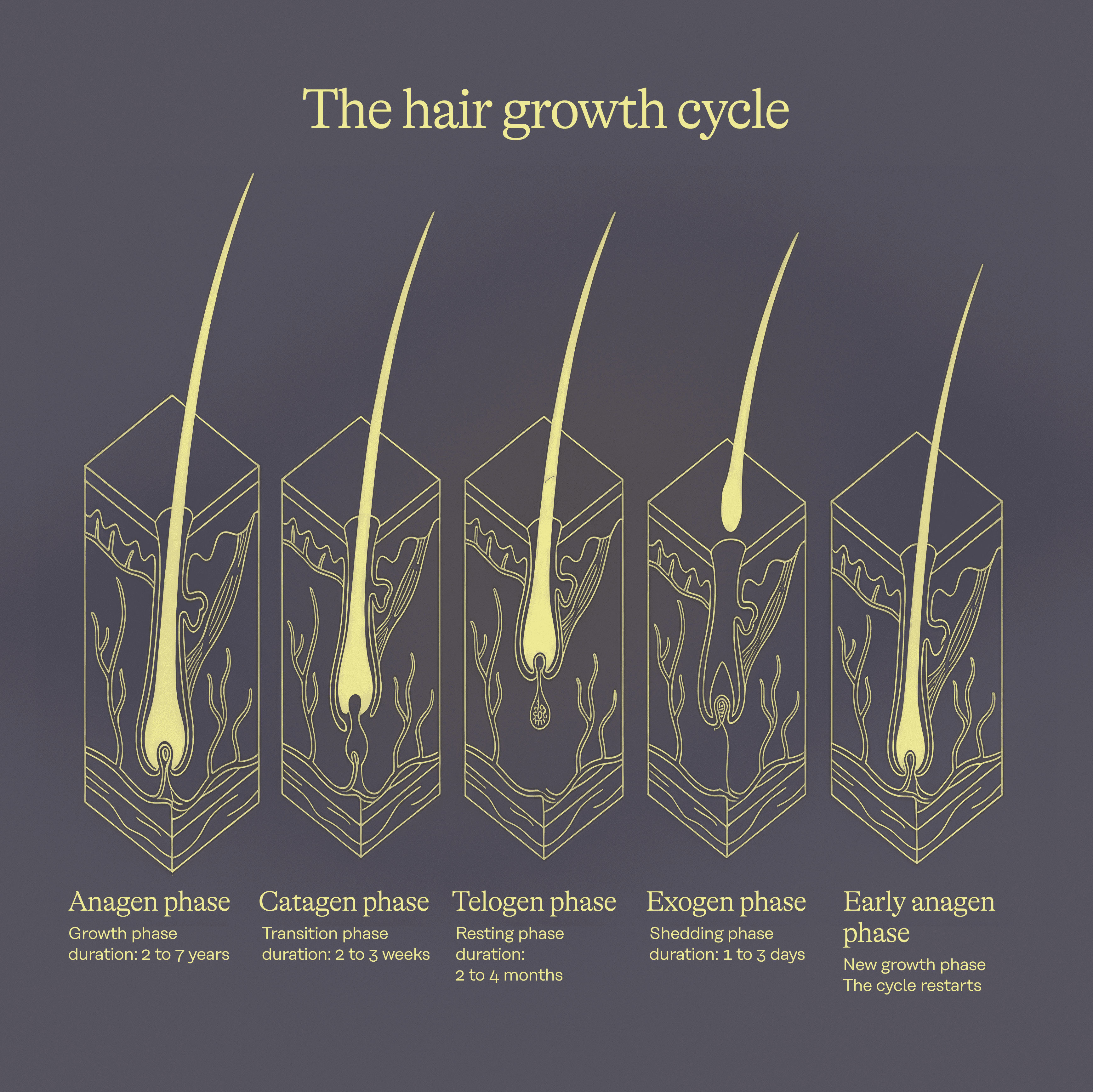
What remains within the normal range
Mild, diffuse shedding with no visible thinning areas, without a noticeable change from your usual baseline
No sudden change in volume or density over a few weeks
Signs that should prompt us to look deeper
Significant hair loss that persists
A widening part
Loss of density at the crown
Receding temples or hairline
Sudden shedding a few weeks or months after stress, illness, childbirth, surgery, or a hormonal change
Hair that becomes finer, more brittle, and less dense than before
Why are you losing your hair? The key underlying factors to know
Main causes of hair loss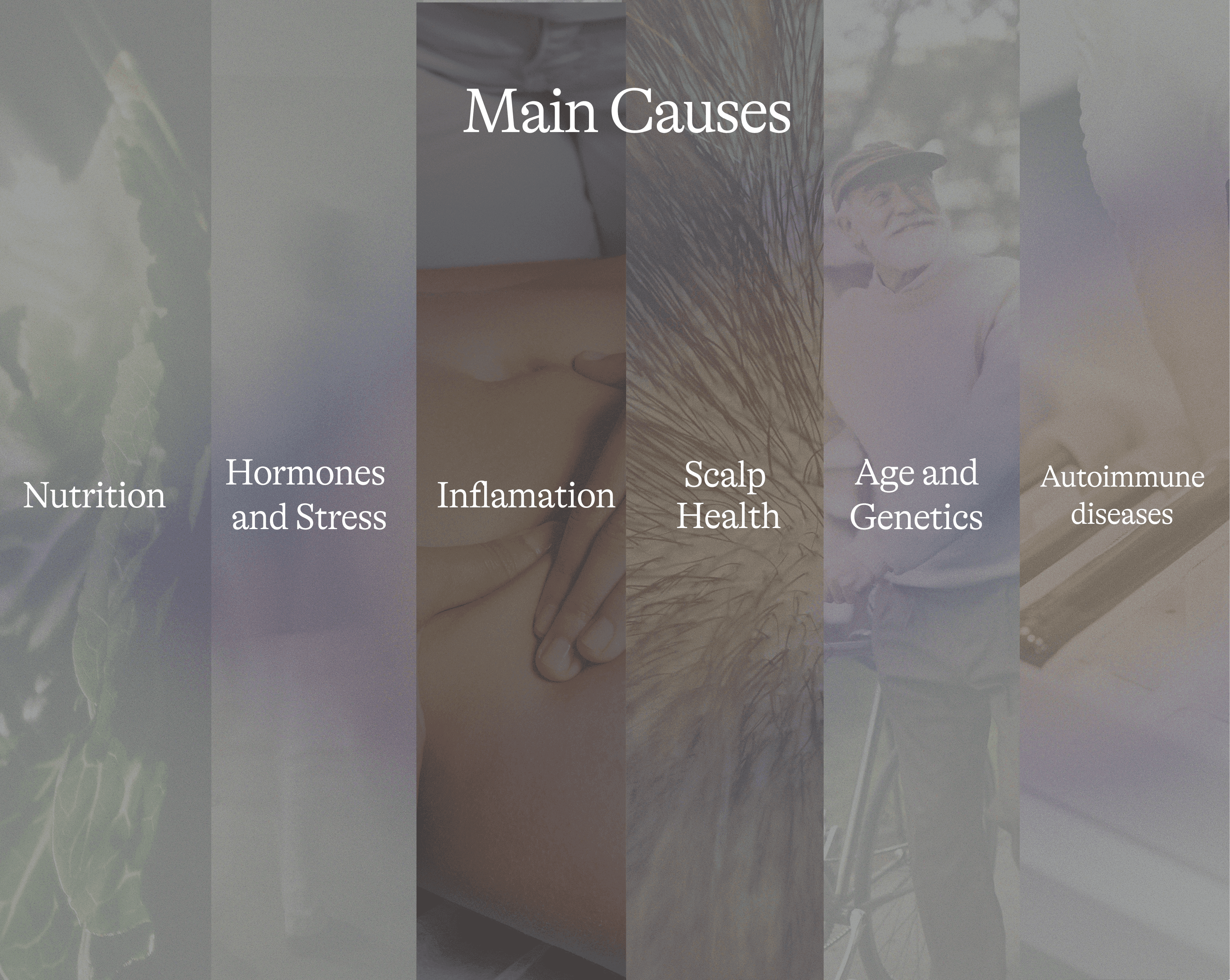
Hair loss is rarely caused by just one factor. In real life, several mechanisms often overlap.
1. Deficiencies or insufficient intake: when the follicle lacks resources
The hair follicle is a highly metabolically active tissue. To maintain its growth phase, it needs energy, protein, iron, and several micronutrients.
Among the factors most often found in lab work:
Low ferritin / iron deficiency, sometimes even without overt anemia
Low vitamin D
Low zinc
Sometimes B12 or folate, depending on dietary or digestive context
What you may notice: diffuse shedding, finer hair, duller hair, less regrowth, overall loss of density.
Useful biomarkers: CBC, ferritin, iron, transferrin saturation, vitamin D, B12, folate, zinc.
2. Hormones: androgens, estrogens, and thyroid
Hair is highly sensitive to the hormonal environment.
Androgens and DHT
In both men and women, some forms of hair loss are linked to progressive follicle miniaturization, classically under androgen influence. In women, this often appears as a widening of the central part and reduced density on the top of the scalp. In men, the pattern is more classic: temples, vertex, and hairline.
In some women, this pattern may be encouraged by androgen excess, particularly in the context of PCOS.
Estrogens
Female hormonal shifts also matter. A sharp drop in estrogen can promote increased shedding, especially after childbirth or after stopping an estrogen-containing treatment. This is also one reason why some women notice changes in their hair during perimenopause and after menopause.
Thyroid
The thyroid plays an important role in normal follicle function. Both hypothyroidism and hyperthyroidism can be associated with diffuse hair loss. This is an axis that should not be overlooked, especially if the hair loss is accompanied by other signs such as fatigue, feeling cold, constipation, palpitations, weight loss or gain, cycle irregularities, or skin changes.
Useful biomarkers: TSH, free T4, free T3, thyroid antibodies, total and free testosterone, SHBG, DHEA-S, and depending on the context, estradiol.
3. Physiological stress and telogen effluvium: the delayed "shock"
This is probably one of the most common mechanisms when the shedding is sudden, diffuse, and dramatic.
A major stressor can push a large number of follicles into the resting phase. The consequence is not immediate: shedding often appears 2 to 3 months later, sometimes longer.
Common triggers include:
Infection or fever
Surgery
Childbirth
Rapid weight loss
Under-eating
Major emotional stress
Physical or mental overwork
Certain medications
What you may notice: diffuse shedding, often in handfuls, even though the hair previously seemed normal.
This can be very distressing, but the good news is that this type of hair loss is often reversible, provided the trigger is identified and the underlying terrain is corrected.
4. Inflammation, metabolic health, and insulin
The follicle does not exist in isolation. It is influenced by the broader terrain: low-grade inflammation, insulin resistance, androgen excess, and metabolic dysfunction.
In some women, especially in the context of PCOS or hyperandrogenism, insulin may indirectly contribute to the problem by promoting increased androgen production. In both men and women, metabolic dysfunction can also aggravate an inflammatory terrain that is already unfavorable to the follicle.
Metabolic health can be part of the picture, especially when it overlaps with hormonal or inflammatory factors.
Useful biomarkers: fasting glucose, fasting insulin, HbA1c, high-sensitivity CRP.
5. Scalp disorders, autoimmune forms, and scarring hair loss
Not all hair loss is related to deficiencies or hormonal imbalance.
Some cases require prompt dermatological evaluation:
Alopecia areata: round or oval well-defined patches, often autoimmune in origin
Frontal fibrosing alopecia: progressive recession of the frontal hairline, sometimes with eyebrow loss
Seborrheic dermatitis, psoriasis, fungal infections: scaling, itching, local inflammation
These situations should not be minimized and require dermatological consultation.
Age and genetics also play a role in hair health. They influence follicle sensitivity, the rate of miniaturization, and the likelihood of developing certain forms of progressive hair loss, particularly androgenetic alopecia. But even here, predisposition does not mean inevitability: identifying the underlying terrain early often allows for more effective action.
Losing your hair can be very destabilizing. It can affect self-image, confidence, and sometimes even social life. But one essential point is worth remembering: hair loss is often an early signal. In other words: the earlier the cause is identified, the more options there are to act.
Which biomarkers can help us understand what is going on?
At Lucis, we analyze more than 100 biomarkers, several of which can help clarify hair loss depending on the context:
Iron status: ferritin, iron, transferrin saturation
Thyroid: TSH, free T4, free T3, antibodies
Hormones: testosterone, SHBG, DHEA-S, and in some cases female hormones
Inflammation: high-sensitivity CRP
Metabolism: glucose, insulin, HbA1c
Micronutrients: vitamin D, B12, folate, zinc
The goal is to understand the terrain, so that we can act with more precision, in a more personalized way, and avoid generic solutions.
To go further listen to our special episode on hair loss on the Lucis podcast
With Jonathan Encaoua, founder of Oma & Me (a brand specializing in hair health), we decode the real causes of hair loss in both men and women, the myths we still hear everywhere, and the concrete steps to take BEFORE it's too late.
The information contained in this article is provided for educational purposes only and does not constitute medical advice. It does not replace consultation with a qualified healthcare professional. In the case of significant, sudden, localized, or persistent hair loss, medical or dermatological advice is recommended.
References
Almohanna HM, Ahmed AA, Tsatalis JP, Tosti A. The Role of Vitamins and Minerals in Hair Loss: A Review. Dermatol Ther (Heidelb). 2019;9(1):51-70.
Babadjouni A, Mesinkovska NA. Hair Loss in Menopause. Menopause. 2022;29(6):741-744.
Fabbrocini G, Cantelli M, Masara A, et al. Female pattern hair loss: A clinical, pathophysiologic, and therapeutic review. Int J Womens Dermatol. 2018;4(4):203-211.
Grymowicz M, Rudnicka E, Podfigurna A, et al. Hormonal Effects on Hair Follicles. Int J Mol Sci. 2020;21(15):5342.
Harwood JM, Chakmakjian M, Kroumpouzos G. Female Pattern Hair Loss and Polycystic Ovary Syndrome: A Review. Skin Appendage Disord. 2023;9(1):1-7.
National Institute on Aging. How Stress Causes Hair Loss. 2023.
Peters EMJ, Muller Y, Snaga W, et al. Hair and stress: A pilgrimage through hair follicle neuroimmunology. Biochem Pharmacol. 2022;201:115073.
Phillips TG, Slomiany WP, Allison R. Hair Loss: Common Causes and Treatment. Am Fam Physician. 2017;96(6):371-378.
Rossi A, Bellisario M, Dario V, et al. Postpartum Telogen Effluvium: Literature Review and Clinical Study in a Cohort of Women. Int J Womens Health. 2024;16:175-186.
Trost LB, Bergfeld WF, Calogeras E. The diagnosis and treatment of iron deficiency and its potential relationship to hair loss. J Am Acad Dermatol. 2006;54(5):824-844.
Written by Anaïs Gautron
More insights, straight to your inbox.
New articles on biomarkers, performance, and wellness. No noise, just substance.